Social Autopsy
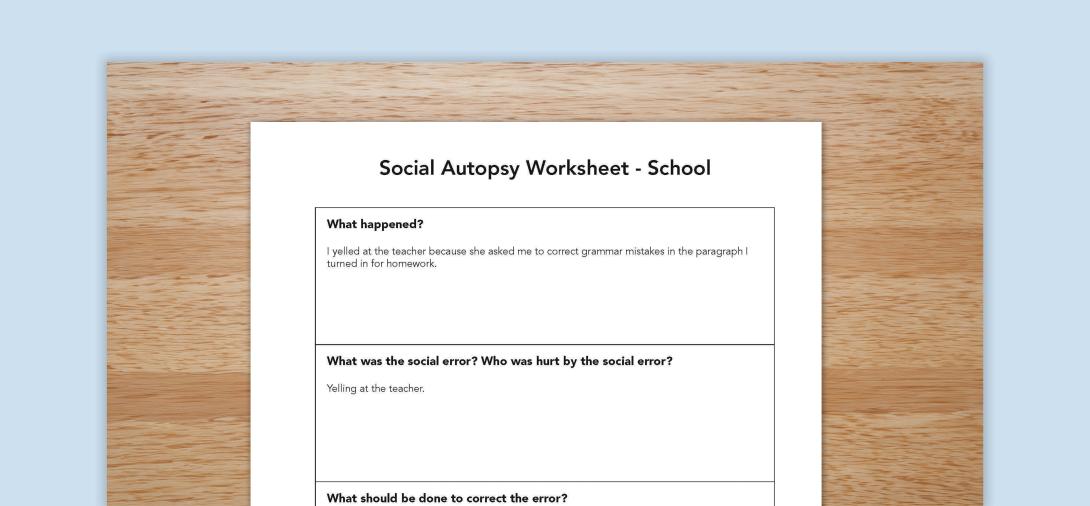
The Social Autopsy is a structured tool designed to help students analyze social interactions, recognize mistakes, and develop strategies for responding more appropriately in the future. By breaking down social situations into key components, students gain a deeper understanding of their actions, the impact on others, and ways to improve their social problem-solving skills.
When to Use:
- Help students analyze social situations where they struggled or made a mistake.
- Support reflection on interactions by guiding students to recognize alternative responses.
- Teach problem-solving by guiding students to recognize alternative responses.
- Encourage accountability by helping students understand the consequences of their actions and plan for the future.
How to Use:
- Introduce the Social Autopsy -
- Explain “This tool helps you think about a social situation that didn’t go well, understand what happened, and figure out how to handle it better next time.”
- Introduce the key steps:
- Identifying what happened
- Recognizing mistakes
- Determining impact
- Problem-solving
- Creating a plan for future success
- Model the Process Step-by-Step -
- Describe the situation - Ask the student to recall and describe what happened.
- Identify the mistake - Guide the student in recognizing what went wrong.
- Determine who was affected - Discuss how their actions impacted themselves and others.
- Explore alternative responses - Brainstorm different ways to handle the situation.
- Develop a prevention plan - Help the student create a strategy to improve their response in similar situations.
- Provide Guided Practice with Prompts - Offer verbal, visual or written prompts as needed. If they struggle to identify alternatives, provide structured options. For example, rather than interrupting a conversation, discuss responses such as waiting for a pause, raising a hand, or using a signal to ask for attention.
- Model and Role-Play the Plan - Before encountering a similar situation, practice alternative responses through role-playing. This allows the student to rehearse appropriate behaviors in a supportive environment.
- Follow Up with the Student - After the student applies their new strategy in a real situation, check in to discuss how it went. Reinforce positive efforts and adjust if needed.
Tips:
- Use visuals, such as charts or graphic organizers, to help students break down social interactions.
- Maintain a positive and supportive tone, focusing on reinforcing progress.
- Ensure discussions take place in a private and calm setting to encourage honest reflection.
Variations:
- Use visuals, such as Comic Strip Conversations or Social Stories to illustrate alternative responses.
- Incorporate video modeling to show examples of expected social behavior.
- Adapt for younger students by using simplified language and pictures instead of written responses.
Related Content

Autism, Inclusion
Social Skills Training
Learn how social skills training is designed to teach learners with autism to appropriately interact with typically developing peers.
View Course