Five Point Scale
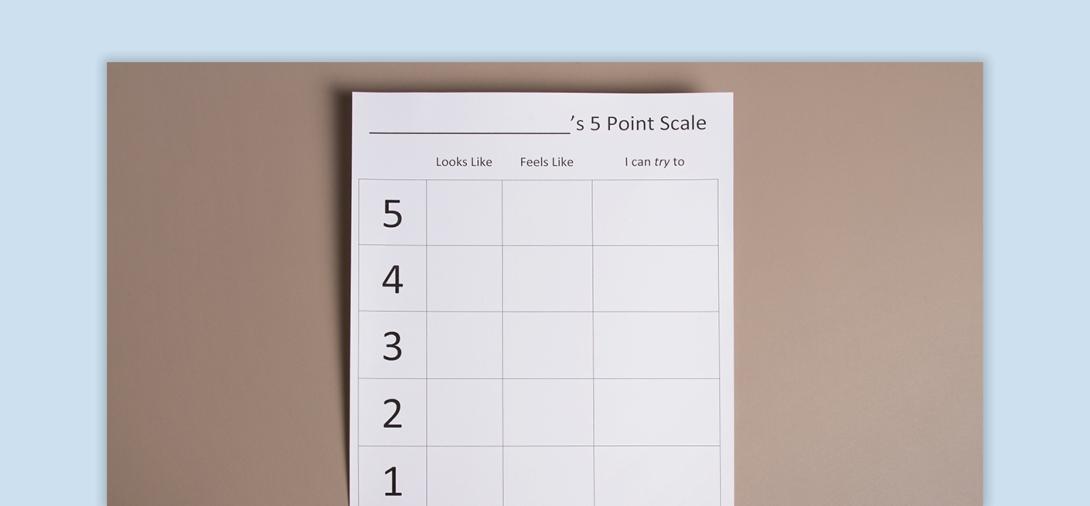
The Five Point Scale is a visual tool designed to help students identify, understand, and regulate emotions, behaviors and abstract concepts. By using a structured scale, students can learn to recognize their emotional state and apply coping strategies to self-regulate.
When to Use:
- To Support Emotional Regulation - Helps students identify their level of distress and apply strategies to return to a calm state
- To Teach Social Behaviors - Provides a structured way to discuss expected vs. unexpected behaviors in various settings
- To Increase Self-Awareness - Helps students reflect on their emotions and reactions in a non-judgmental way
- For Students Who Need Visual Supports - Useful for students who struggle with verbalizing emotions or recognizing behavioral cues
- To Proactively Prevent Escalation - Encourages students to self-identify their state before reaching a crisis point
How to Use:
- Identify the Target Emotion or Behavior - Decide what the scale will address (e.g., anxiety, frustration, voice volume, aggression levels). Ensure it aligns with the student’s needs and challenges.
- Create the Scale - Develop a customized Five Point Scale that includes numbers (1-5), descriptive words, and visuals. (If appropriate, you can involve the student in choosing words and examples to increase the personal connection to the tool).
- Example for Frustration Levels:
- 1- Calm (I feel good, ready to learn)
- 2 - A Little Frustrated (I’m slightly bothered but okay)
- 3 - Upset (I’m starting to feel overwhelmed)
- 4 - Very Angry (I might lose control soon)
- 5 - Crisis (I need help immediately)
- Explicitly Teach the Scale - Model and role-play different emotions using the scale. Reinforce self-identification by regularly asking “Where are you on the scale?” Discuss what strategies the student can use to move back to a 1 or 2.
- Practice and Reinforce Use - Use the scale in real-time situations to help students recognize their emotions. Reinforce students through praise for accurately identifying their state and applying self-regulation strategies.
- Encourage Problem-Solving - When a student reports a higher level (e.g., 4 or 5), help them brainstorm ways to decrease intensity.
Tips:
- Make it Student-Centered - If appropriate, involve students in creating their scale for better engagement and ownership.
- Keep it Visible and Accessible - Place the scale in a common area or provide students with a personal copy.
- Reinforce Positively - Praise students when they use the scale independently.
- Use Non-Judgmental Language - Encourage students to self-identify without fear of punishment.
- Pair with Visuals - Some students may benefit from color-coding (e.g., Green (1) - Red (5)) or emoji representations ((😀- 1) - (😡- 5)).
- Modify for Individual Needs - Some students may need a three-point scale instead of five for simplicity.
Variations:
- Mini Pocket-Sized Scale - Provide students with a laminated keychain version for portability.
- Different Topics - Use the Five Point Scale to teach voice volume, anxiety levels, personal space awareness, or focus levels.
- Color-Coded Emotion Charts - Instead of numbers, use colors or facial expressions for students who respond better to visual cues.
- Whole-Class Application - Implement a class wide emotional check-in system where students self-identify their level at the start of the day.
Related Courses

Autism
Visual Supports
Discover the power of visual supports for supporting students with ASD. Learn about implementation steps, skills, and resources to enhance independence.
View Course

Autism, Behavior
Self-Management
Discover self-management interventions for learners with ASD. Define, implement, and locate resources for teaching self-regulation skills.
View Course