Data Collection: Task Analysis
(upbeat music) (text whooshing) - Task analysis is the process of breaking down a task, skill, or process into smaller steps. It's an evidence-based practice that can be used to help students learn new skills and become more independent. This method of data collection is helpful for complex skills that are made up of multiple steps or functional routines like washing hands or getting lunch in the cafeteria. I use it mostly for my students receiving special education services who are accessing the TEKS at prerequisite levels and who require instruction and assessment in more unique, non-traditional methods than I use with most students.
Here's the task analysis template I use. Task analysis helps me identify which steps a student can complete independently. I can also pinpoint which steps the student struggles with and investigate what type of supports may be needed to help the student progress to mastery. Task analysis helps me see small amounts of progress students are making, such as becoming more independent on more parts of a task over time.
Once I've determined the target skill I want my students to learn, I can use this form to segment that skill into more manageable components. This column will be used later when I'm working with the student to document the level of prompting needed for each step. I can also list the materials needed for this lesson in the notes section. Before presenting the activity to the student, I like to have one of my paraprofessionals or another teacher follow each of the steps in order to see if they catch any detail I may have left out.
For some of my students with more complex access needs, I can anticipate ahead of time that they may need a certain support for a specific step. I can go ahead and write those into the steps section of the task analysis when I'm preparing my data form. I'll fade those initial presentation supports over time, creating a new task analysis as the student becomes more independent. I can use task analysis for academics, such as tracking one of my student's IEP goals for math performance on two-digit subtraction without regrouping.
I listed the steps the student needed to complete the math problem here. Then, when I watched him work the problem, I noted which supports he needed here. You can see that on step 1 he was independent. On steps 2 and 3, he required a verbal direction from me to complete the step.
On steps 4 and 5, I had to model the step for the student for him to complete it. I'll continue taking data to monitor his progress, and hopefully I can fade away the supports that he needs over time as he builds skill. I can use task analysis for functional skills as well. Currently, I'm collaborating with the occupational therapist and monitoring one of my students' IEP goals on using scissors to cut a straight line.
Using scissors develops fine motor skills, hand-eye coordination, and bilateral coordination, which is important for increasing independence with handwriting. I listed the steps the student needed to complete the task here, using the notes section to indicate that only the student's first three cuts will be measured with this task analysis and that the student is right-hand dominant. Then, when I worked with her on the task, I noted which support she needed here. You can see that on most of the steps she was independent.
On the steps that required her to align the scissors with the line, I had to physically assist her. Like with the math example, I'll continue taking data to monitor her progress, reducing the supports needed as she becomes more independent. With my students, task analysis really helps me identify how they're performing on each part of a larger skill or task. (upbeat music)
This video shows one educator sharing how she uses a task analysis data collection form.
This form can be used to break down the steps of an activity and indicate the support the student required for each step.
Task analysis is the process of breaking down a task, skill, or process into smaller steps. An educator identifies which steps a student can complete independently, then investigates what supports the student may need to learn the other steps while working towards mastery.
Educators may find this tool most useful for students who are accessing the curriculum (TEKS) at prerequisite levels and routinely participate in alternate or non-traditional methods of assessment. These students may be in the process of developing a functional and consistent mode of communication (e.g., currently non-verbal, uses very limited non-symbolic communication) and require individualized supports (e.g., modifications, task analysis, direct instruction, assistive technologies, first/then charts, tactile schedules, social narratives) and ongoing adult assistance (e.g., prompting, cueing, physical assist) to participate in on-topic academic exchanges.
Related Resources
Significant Cognitive Disabilities,
Instruction
This form can be used to break down the steps of an activity and indicate the support the student required for each step.
Significant Cognitive Disabilities
Explore the key themes from Quality Indicator II: Effective Teams in the Rubric of Effective Practices for Students with Significant Cognitive Disabilities.
Significant Cognitive Disabilities,
Instruction
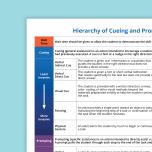
This chart organizes the levels of support a student might need from least to most invasive.