Data Collection: Trial by Trial Recording
I use trial by trial data the most in my classroom. I find it helpful for both grades and progress monitoring of IEP goals.
It's a great way to track my student performance on the hands on tasks they do in my classroom.
With Shiloh, his IEP goal focuses on correctly identifying objects in sets of three within sets of one, two, and three. Today, I'm going to take data on an activity using our classroom counting blocks. I will ask Shiloh to find the set of three and he will respond by pointing to the group of objects he thinks has three. Let's see how it goes.
Find the set of three, find the set of three, Find the set of three.
Find the set of three.
Find the set of three.
Find the set of three.
Find the set of three.
Find the set of three.
Find the set of three Find the set of three.
I can calculate Shiloh's performance for this activity at eight out of ten correct, so he had eighty percent accuracy on this task.
Trial by trial data may be reported in trials or in percentages depending on how an IEP goal is written. I've used it to report on student motor skills, such as the number of trials where the student kicked the ball in physical education. With vocational prep for a student working in housekeeping, I reported on the percentage of towels in a stack that were folded correctly. You can see how trial by trial data can be used for many different hands on tasks.
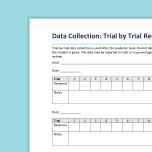
This video shows one educator sharing how she uses a trial-by-trial data collection form. This form is intended for use by teachers, paraprofessionals, and other service providers collecting data for student Individualized Education Program (IEP) goals and baseline data to determine a need for new/updated IEP goals or behavior intervention.
Trial-by-trial data collection is used often for academic tasks. Record data for each opportunity, or trial, the student is given. The data may be reported in trials or in percentages, depending on how the goal is written.
If you have questions about when or how often to collect data, refer to the student’s IEP and/or reach out to their Admission, Review, and Dismissal (ARD) committee members for guidance.
Related Resources
Significant Cognitive Disabilities
Explore the key themes from Quality Indicator II: Effective Teams in the Rubric of Effective Practices for Students with Significant Cognitive Disabilities.
Significant Cognitive Disabilities,
Instruction
This video shows one educator reviewing some of the data collection forms used frequently by her classroom team.
ARD/IEP Supports,
Significant Cognitive Disabilities,
Autism,
Behavior,
Evaluation,
Instruction
Trial-by-trial data collection is used often for academic tasks. Record data for each opportunity, or trial, the student is given. The data may be reported in trials or in percentages, depending on how the goal is written.
Significant Cognitive Disabilities,
Instruction
This month’s focus is on building relationships and collecting data. The content aligns with Quality Indicator II: Effective Teams on the Rubric of Effective Practices for Students with Complex Access Needs and the Administrator Companion Document to the Rubric of Effective Practices for Students