Special Circumstances
Children enrolled in Texas schools speak more than 120 different languages. Consequently, in Texas many children with disabilities are also identified as students who are emergent bilingual. Children with disabilities may also be identified as gifted in comparison to same-aged peers.
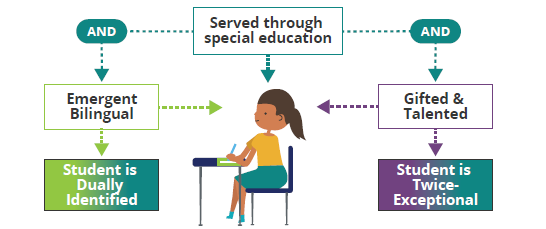
EB Students
Emergent Bilingual (EB) Students
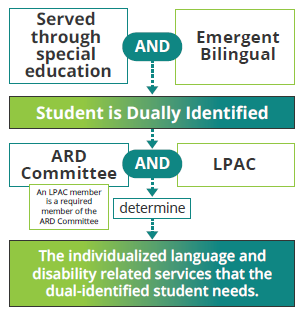
When a child with a disability is, or might be, identified as EB, the child’s ARD committee must work in conjunction with the language proficiency assessment committee (LPAC) for all decision making regarding the whole child.
Important topics for members of the ARD and LPAC committees who work directly with the student to consider include:
- the student's cognitive and linguistic abilities, and affective needs;
- linguistic accommodations that will help the student access the general curriculum; and
- interaction of language and disability related needs.
Continuous communication and ongoing coordination between both the LPAC and ARD committees is best practice.
Assessment Instruments
For students with disabilities, school districts shall utilize the state's criteria for identification of emergent bilingual students as described in TAC §89.1226(f) of this title (relating to Testing and Classification of Students) and shall establish placement procedures that ensure that the placement recommendation by the LPAC committee, in conjunction with the ARD committee, in a bilingual education or English as a second language program is not refused based on the student's disabling condition.
GT Students
Twice-Exceptional Learner
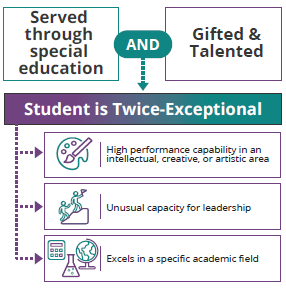
A twice-exceptional learner is a child who is GIFTED AND TALENTED and qualifies for special education services. Based on LEA criteria, a child may be gifted and talented if he or she performs at or shows the potential for performing at a remarkably high level of accomplishment when compared to others of the same age, experience, or environment and who:
- exhibits high performance capability in an intellectual, creative, or artistic area;
- possesses an unusual capacity for leadership; or
- excels in a specific academic field.
Twice-exceptional children tend to fall into one of these three categories, complicating identification:
- Students whose giftedness masks their learning and attention issues.
- Students whose learning and attention issues mask their giftedness.
- Students whose learning and attention issues and giftedness mask each other.
Assistive Technology
Assistive Technology
The ARD committee must consider whether the child needs ASSISTIVE TECHNOLOGY devices or services.
The term assistive technology device (ATD) is any item, piece of equipment, or product system, whether acquired commercially off the shelf, modified, or customized, that is used to increase, maintain, or improve functional capabilities of the child with a disability. The term ATD does not include a medical device that is surgically implanted or the replacement of such device.
The term assistive technology service means any service that directly assists the child with a disability in the selection, TEA Photo Library acquisition, or use of an ATD and includes the evaluation of the needs of the child, including a functional evaluation of the child in the child's customary environment. Rather than a one-time “event” conducted by a specialist, assistive technology assessment is best thought of as a collaborative process by which a team (e.g., ARD committee) determines what technologies would improve a student's performance, participation, and independence.
The consideration of assistive technology devices and services is required during the development of every IEP and every IFSP for children from birth to school age.
BEST PRACTICE TIP
The Quality Indicators for Assessment of Assistive Technology Needs (listed 1-7 below), is a process used to identify tools and strategies to address a student’s specific need(s):
- Assistive technology assessment procedures are clearly defined and consistently used.
- Assistive technology assessments are conducted by a MDT that actively involves the student and family or caregivers.
- Assistive technology assessments are conducted in the student’s customary environments.
- Assistive technology assessments, including needed trials, are completed within reasonable timelines.
- Recommendations from assistive technology assessments are based on data about the student, environments and tasks.
- The assessment provides the ARD committee with documented recommendations about assistive technology devices and services.
- Assistive technology needs are reassessed by request or as needed based on changes in the student, environments and/or tasks.
Resources
- Dually Identified Technical Assistance Guide
- Guidance Related to ARD Committee and LPAC Collaboration
- Bilingual and English as a Second Language Education Programs
- Emergent Bilingual Student Data Review – Supplemental Form
- Students Served by Special Education and Identified as Gifted and Talented
- Considering Assistive Technology (AT) in the Individualized Education Program (IEP) Process
- Assistive Technology Industry Association (ATIA)