Reevaluation
WHEN
When must you conduct a reevaluation?
A reevaluation must be conducted not more often than once a year, unless the parent and the LEA agree otherwise and at least every 3 years, unless the parent and the LEA agree that reevaluation isn’t necessary. The reevaluation must be conducted if the LEA determines that a reevaluation is warranted based on the student’s educational or related services needs, or if the child’s parent or teacher requests one. Additionally, the local educational agency shall evaluate a child with a disability before determining that the child is no longer a child with a disability.
WHO
Who can request a reevaluation?
Reevaluations may be requested by any member of the ARD committee, including parents and teachers, prior to the triennial due date.
WHAT
What is a reevaluation process?
A reevaluation includes a review of existing evaluation data (REED), as well as current input from a child’s parents and teachers so that a decision can be made regarding continued eligibility or need for further assessments.
A REVIEW OF EXISTING EVALUATION DATA (REED) is required as part of any reevaluation.
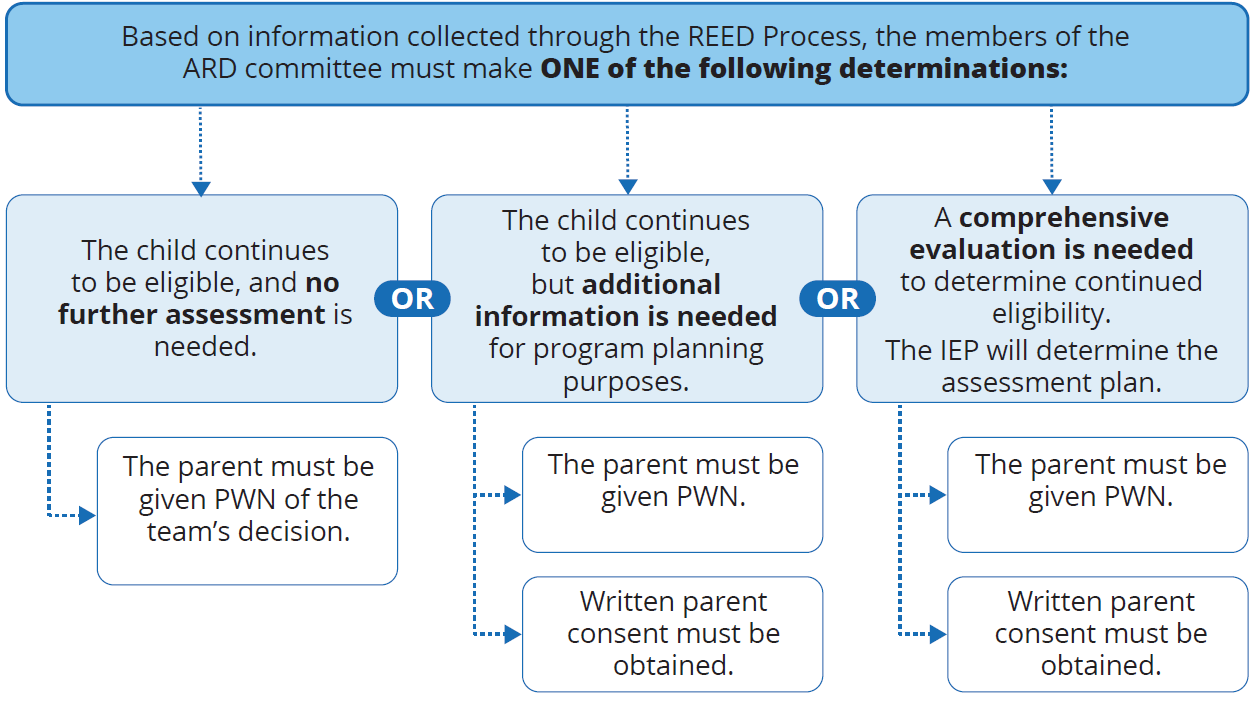
Based on the REED, the ARD committee, which includes the parent, and other qualified professionals as appropriate, must determine what additional data, if any, are needed to determine whether the child continues to be a child with a disability and whether the child continues to need special education and related services.
Based on the REED, the team must identify any additional data needed to determine:
- Whether the child continues to have a disability;
- Whether the child continues to need special education and related services;
- The present levels of academic achievement and functional performance (PLAAFP) of the child; and related developmental needs of the child;
- Whether any additions or modifications to the special education and related services are needed to enable the child to meet the measurable annual goals set out in his or her IEP and to participate, as appropriate, in the general education curriculum.
Additional data NOT needed:
If the group conducting a REED determines that no additional data are needed, the LEA must notify the student’s parent. Best practice is to document this notification in writing through the deliberations and/or prior written notice:
- The group’s determination and the reasons for the determination; and
- Their right to request an evaluation to determine whether the student continues to have a disability and to determine the student’s educational needs.
It is important for an LEA in the REED process to carefully consider the reevaluation due date because if a parent requests additional evaluations after the LEA informs the parent of its determination that no additional data are needed, any additional evaluations must be completed in a timely manner, as there is no extension of the reevaluation deadline. If the parent or the adult student does not request additional evaluation, the LEA is not required to conduct further evaluation, and the REED may constitute the student’s three-year reevaluation. The date of the REED establishes the new three-year reevaluation date.
Additional data NEEDED:
If the group conducting the REED determine that additional data are needed, the team must indicate what additional data is needed and obtain informed parent consent. To meet federal requirements, the ARD committee members must document what data was reviewed and based on that review, what data is needed.
Then the LEA must:
- Provide the parent with the Notice of Procedural Safeguards, and PWN that describes any assessment that it proposes to conduct,
- obtain consent from the parent, and
- administer the assessments and evaluation measures needed to produce the necessary data on or before the three-year reevaluation due date.
When assessments are complete, the ARD committee will convene to review evaluation results and make any necessary eligibility determinations or changes to the child’s IEP.
BEST PRACTICE TIP
A REED should be completed at least 45 school days before the three-year anniversary date. If additional data is needed, the information must be obtained prior to the reevaluation due date.
Reevaluation Procedures
NOTE
- The REED must be conducted by the members of the student’s ARD committee, and others as appropriate. However, this review process does not have to take place in an ARD committee meeting.
- A REED may or may not lead to additional testing/assessment procedures.
- The LEA must make reasonable efforts to obtain informed consent for a reevaluation. If the parent does not respond, despite reasonable efforts, the reevaluation can proceed.
If the parent refuses to consent to the reevaluation:
- The LEA may pursue the reevaluation using mediation or due process procedures.
- The LEA does not violate its obligation under the CHILD FIND DUTY and the EVALUATION PROCEDURES requirements if it declines to pursue the reevaluation.
NOTE
The LEA must maintain documentation of RECORDS OF ATTEMPTS to obtain parental consent. Those procedures include detailed records of phone calls, copies of correspondence, and detailed records of visits to the parents' home or job.