Referral for Special Education and Related Services
Who Can Make a Referral for Special Education?
The student's parent or legal guardian, school personnel, or another person involved in the education or care of the student can make a referral for special education. An LEA may not deny a referral or delay an initial evaluation because pre-referral interventions have not been implemented with a student.
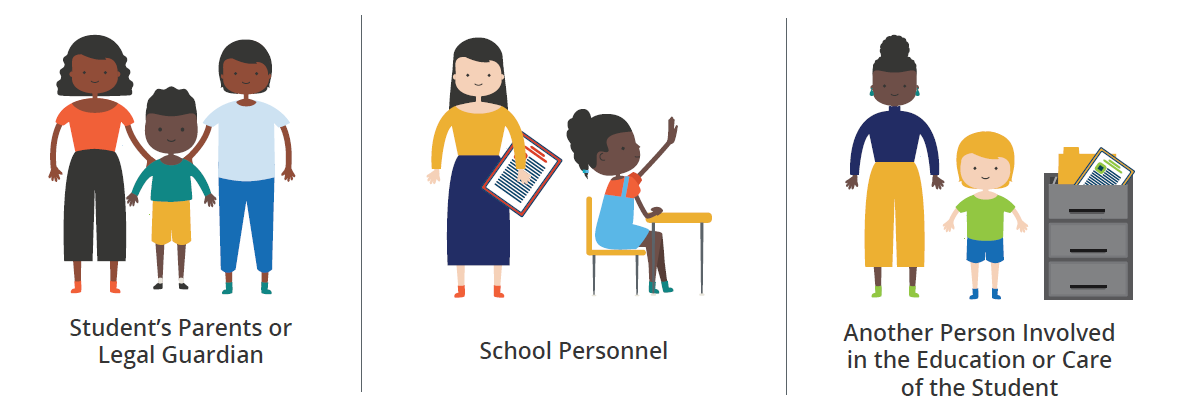
If a parent makes a written request to the LEA’s special education director or to an LEA administrative employee for an initial evaluation for special education and related services:
- The LEA must respond no later than 15 school days after receiving the request.
- The written request must be made to the LEA’s special education director or to an LEA administrative employee for the 15-school day response requirement to apply.
- The written request can be made in a language other than English.
- At that time, the LEA must give the parent a prior written notice (PWN) of whether it agrees or refuses to evaluate the student, along with a copy of Notice of Procedural Safeguards.
- If an LEA suspects, or has reason to suspect, a student has or may be a child with a disability under IDEA, the LEA must provide parents with the Overview of Special Education for Parents form developed by TEA explaining rights under IDEA that may be additional to rights under Section 504.
- If the LEA agrees to evaluate the student, it must also give the parent the opportunity to give written consent for the evaluation.
NOTE
- A request for a special education evaluation may be made verbally and is not required to be in writing. A verbal request does not require the LEA to respond within the 15-school day timeline.
- When requests are made verbally, LEAs must still comply with all federal PWN and procedural safeguard requirements.
BEST PRACTICE TIP
LEAs are encouraged to respond to all verbal requests for evaluation within 15 school days. It is best practice to ask someone who is making a verbal request to place the request in writing.
General Education Interventions
If a student who is not receiving special education services receives assistance from the LEA for learning difficulties, the LEA must notify the parent that it is providing this assistance to the student. The notification must be provided when the LEA begins providing the assistance and must also be provided each school year. Students having trouble in the general education classroom should be considered for all support services available to all students, such as:
- Tutorial services
- Compensatory services
- Multi-Tiered Systems of Support (MTSS), or response to other evidence-based intervention
- Other academic or behavior support services
MTSS is a school-wide framework that is meant to provide varying levels of support to meet the academic, behavioral, and mental health needs of students. MTSS includes the term response to intervention (RtI) for academics and/or behavior and other early intervention strategies. TEA has various resources and trainings about MTSS available at the Texas Sped Support website.
While an FIIE is being conducted, a student must continue to receive any necessary interventions and support services to target their academic or behavioral needs.
An LEA may not deny a referral or delay an initial evaluation because MTSS or other interventions have not been implemented with a student. If there is a basis for suspecting the student has a disability and needs special education, the student must be referred for an evaluation regardless of whether he or she has participated in an intervention program.
NOTE
The Office of Special Education Programs (OSEP) issued a letter and two memos regarding denying or delaying a special education initial evaluation.
“(An) MTSS/RTI (approach) may not be used to delay or deny a full and individual evaluation under 34 CFR §300.304-300.311 for a child suspected of having a disability. With respect to preschool children, IDEA does not require or encourage a local or preschool program to use a MTSS approach prior to referral for evaluation or as part of determining whether a 3-, 4-, or 5-year-old is eligible for special education and related services. Once an LEA receives a referral from a preschool program, the LEA must initiate an evaluation process to determine if the child is a child with a disability.
Please note that the content of these memoranda reflects IDEA statutory and regulatory requirements.
- OSEP Memorandum 11-07--A Response to Intervention (RTI) Process Cannot Be Used to Delay-Deny an Evaluation for Eligibility under the Individuals with Disabilities Education Act (IDEA) (January 21, 2011); and
- OSEP Memorandum 16-07--A Response to Intervention Process Cannot be Used to Delay-Deny an Evaluation for Preschool Education Services under the Individuals with Disabilities Education Act (April 29, 2016). “
Multiple data sources must be considered, and the cumulative impact may rise to the level of suspecting a disability and need for special education services.
- Lack of expected gains during intervention progress monitoring
- Hospitalization
- More substantial supports needed as general education curriculum becomes more difficult
- Interfering behaviors and/or discipline referrals
- Outside evaluation/diagnosis provided by a parent
- Parental concerns regarding child’s struggles
- Outside therapeutic services or tutoring
- Gap between expected academic growth and actual growth
- Chronic absenteeism
- Section 504 services not sufficient to address student needs
BEST PRACTICE TIP
- Provide Child Find orientation, training, and support for all campus staff.
- Identify factors that could trigger the need for referring a student for special education services.
- Coordinate and collaborate between general and special educators on effective instruction and evidence-based interventions.
- Establish training and a system that makes documentation easy, practical, and automatic for staff, from Child Find through progress monitoring.
Data-based Decisions
When making data-based decisions it is important to gather and systematically analyze information about students.
Consider:
- Tiered Interventions
- Evaluation for Services and/or Accommodations under Section 504
- Special Education Evaluation
These considerations are NOT sequential processes. They should be simultaneous considerations.
Knowledge or suspicion of a disability alone does not automatically trigger the need to refer a student for special education. The knowledge must be in addition to a reasonable suspicion that, because of the disability or suspected disability, the student may need special education and related services.
Reminder
Two questions must be answered:
- Is there a reason to suspect that the student has a disabiltiy?
- Is there a reason to suspect that because of the disabiltiy the student needs special education and related services?
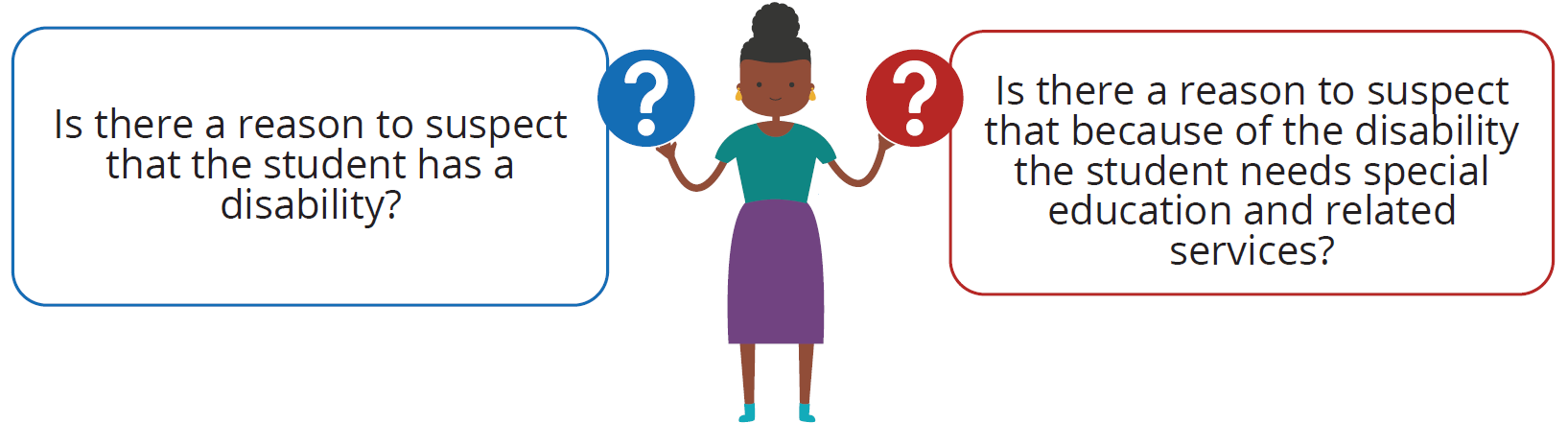
If “Yes” to both questions, refer the student for an FIIE.
Children Who Transfer
- If a child is in the process of being
evaluated for special education eligibility and enrolls in a new LEA before the evaluation is completed, the new LEA MUST coordinate with the previous LEA to ensure prompt completion of the initial evaluation.
- If the child transfers from another LEA when an initial evaluation is pending, the timelines for conducting the evaluation apply to the new LEA unless:
- The new LEA is making sufficient progress to ensure a prompt completion of the evaluation;
and - The parent and the new LEA agree to a specific time when the evaluation will be completed.
- The new LEA is making sufficient progress to ensure a prompt completion of the evaluation;

When a student transfers to a new LEA within the state or outside of the state in the same school year, the new LEA must:
- Verify with the parent or the previous LEA that the student had an individualized education program (IEP) that was in effect in the previous LEA.
- Verify means that the new LEA receives a copy of the student’s IEP in effect in the previous LEA.
- In consultation with the parent, provide a free appropriate public education (FAPE), including services comparable to those described in the student’s IEP from the previous LEA. The new LEA either
- Adopts the child’s IEP from the previous LEA or
- Develops, adopts, and implements a new IEP.
The timeline for adopting the previous IEP or developing, adopting, and implementing a new IEP is 20 school days from the date the student is verified as eligible for special education services.
If the LEA also determines that this in-state transfer student requires a reevaluation, it must ensure that the reevaluation occurs according to 34 CFR, §300.303. A reevaluation may occur not more than once a year unless the parent and the LEA agree otherwise, but one must occur at least every three years unless the parent and the LEA agree that it is not necessary. The LEA would treat the administration of the reevaluation the same way it would for a reevaluation of any other student with an IEP in the LEA.
For students who transfer from outside of the state, if deemed necessary, the new Texas LEA must conduct an FIIE, make an eligibility determination, and, if appropriate, develop, adopt, and implement a new IEP within the timeline established for initial evaluations and initial ARD meetings.
If the new LEA determines that an evaluation is not necessary for the student transferring from outside of the state, the timeline for the new LEA to develop, adopt, and implement a new IEP is 20 school days from the date the student is verified as being a student eligible for special education services.