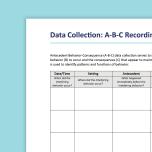
Data Collection: A-B-C Recording
ABC Data looks at a behavior situation in detail. ABC stands for antecedent, behavior, and consequence. I want to know what happened right before the behavior occurred, what specifically did the behavior look like, and what happened right after the behavior.
Identifying these key elements helps me discover patterns in a student's behavior and determine the potential function of that behavior. Knowing that, I can plan interventions and supports for the student.
Let's check on Ariana.
Ariana, time to start your math sheet.
Ariana, that's a mark in your behavior folder. I don't care.
Here's how I would record that interaction using ABC data collection.
I record the antecedent here.
Student was asked to start her math sheet.
I record the behavior here using a very clear description of the actions I observed.
Through pencil and put head on desk.
I record the consequence here.
Mark placed in behavior folder.
It is also helpful to document the effect that the consequence had on the student. In this case, Ariana yelled that she didn't care. I record this here.
Ariana yelled.
I will continue to collect data to see if there is a pattern in Ariana's behavior. If there is a pattern, I will hypothesize the function of that behavior to identify new instructional supports to help her in math or begin teaching her a replacement behavior for when she becomes frustrated.
This video shows one educator sharing how she uses an Antecedent-Behavior-Consequence (A-B-C) data collection form. This form is intended for use by teachers, paraprofessionals, and other service providers collecting data for student Individualized Education Program (IEP) goals and baseline data to determine a need for new/updated IEP goals or behavior intervention.
The A-B-C data collection form serves to identify the antecedents (A) that set the stage for or trigger problem behavior (B) to occur and the consequences (C) that appear to maintain that behavior. Typically, this data is collected over multiple sessions and is used to identify patterns and functions of behavior.
If a pattern of behavior is identified, the Admission, Review, and Dismissal (ARD) committee may determine the need to develop behavioral goals and/or conduct a Functional Behavioral Assessment (FBA) and consider developing a behavior intervention plan (BIP).
Related Resources
Significant Cognitive Disabilities
Explore the key themes from Quality Indicator II: Effective Teams in the Rubric of Effective Practices for Students with Significant Cognitive Disabilities.
Significant Cognitive Disabilities,
Instruction
This video shows one educator reviewing some of the data collection forms used frequently by her classroom team.
ARD/IEP Supports,
Behavior,
Significant Cognitive Disabilities,
Autism,
Evaluation,
Instruction
Antecedent-Behavior-Consequence (A-B-C) data collection serves to identify the antecedents (A) that set the stage for or trigger problem behavior (B) to occur and the consequences (C) that appear to maintain that behavior. Typically, this data is collected over multiple sessions and is used to identify patterns and functions of behavior.
Significant Cognitive Disabilities,
Instruction
This month’s focus is on building relationships and collecting data. The content aligns with Quality Indicator II: Effective Teams on the Rubric of Effective Practices for Students with Complex Access Needs and the Administrator Companion Document to the Rubric of Effective Practices for Students