IDEA Requirements for Placement and School Discipline

States, schools, and communities are understandably genuinely concerned with school safety. Providing a safe environment in which students can learn and be free of drugs and violence, is one of education's top priorities. Students with disabilities are more than twice as likely to be suspended as students without disabilities, and the loss of instructional time increases the risk of repeating a grade and dropping out. At the beginning of the school year, students often receive guidelines on expected standards of behavior, dress, academic integrity, and attendance and the consequences of violating those standards. IDEA addresses the extent to which schools may take disciplinary action when a student with disabilities violates a local code of student conduct.
Discipline decisions have consequences. Studies show that students who receive one out-of-school suspension incident (based on 1-3 days for each suspension) in ninth grade are a quarter less likely than their peers who are not suspended to graduate high school. Studies also show they are a third less likely to enter college, and more than twice as likely to drop out of high school.
The US Department of Education offered the following guidance regarding exclusionary discipline:
NOTE
Proactive systematic approaches that focus on instruction and supports, and that are implemented with fidelity, are likely to address disparities; reduce the use of exclusionary discipline; and result in positive developmental, academic, and behavioral outcomes for all children including those with disabilities. Further, in the Office of Special Education and Rehabilitative Services’ (OSERS’) view, exclusionary discipline should not be used for non-violent offenses such as, tardiness, absenteeism, or subjective offenses such as defiance or disrespect.
BEST PRACTICE TIP
Since research indicates the harmful effects of exclusionary discipline practices, consider alternatives
to classroom removals, depending on the severity of the student's infraction.
Alternatives to Classroom Removals:
- Reteach appropriate behavior and provide time for modeling and practice
- Private discussion and problem solving
- Behavior contract
- Pair with mentor
- Before or after school detention
- Loss of privileges
- Peer mediation programs
- Restorative practices
Out-of-school suspensions are more strongly related to negative outcomes than in-school suspensions (Noltemeyer et al., 2015), so if the behavior is consistent or serious enough to remove the student from the classroom, it is important to pair the following in-school instructional supports with the removal to ensure everyone involved is working towards the student’s successful reentry into the classroom:
- student debrief,
- skills coaching on appropriate behaviors,
- reentry plan with rehearsal, and
- transition supports with a reconnection conversation.
(PBIS Forum 2021: Instructional Alternatives to Exclusionary Discipline)
Types of Disciplinary Removals
| In-School Suspension (ISS) | ISS includes instances in which the student is removed from his or her regular classroom(s) for disciplinary purposes but remains under the direct supervision of school personnel. Direct supervision means school personnel are physically in the same location as the student under their supervision. Beginning on the 11th day of removal the student must receive services that enable progress towards the IEP. Prior to the 11th day of removal, IEP services may be provided. |
|---|---|
| Out-of-School Suspension (OSS) | OSS includes instances in which the student is temporarily removed from his or her regular school to another setting (e.g., home, behavior center) for disciplinary purposes. This includes both removals in which the student receives no IEP services because the removal is 10 days or less and the school district does not provide services to a student without disabilities who is similarly removed, as well as removals in which the student continues to receive services according to his or her IEP. |
| Expulsion | Expulsion involves removing a student from his or her regular school for disciplinary purposes for the remainder of the school year or longer by LEA policy. This includes removals resulting from violations of the Gun-Free Schools Act. IEP services continue, and the student will receive FAPE. |
| Removal by Hearing Officer | An impartial hearing officer may order the removal of a student from his or her current educational placement to an appropriate alternative educational setting for not more than 45 school days based on the hearing officer’s determination that maintaining the student’s current placement is substantially likely to result in injury to the student or others. The ARD committee is responsible for determining the IAES and will continue implementing the IEP services. |
| ARD Committee Removal to Interim Alternative Educational Setting (IAES) | The ARD committee determines an appropriate IAES for no more than 45 school days. This setting enables the student to continue to receive educational services and participate in the general education curriculum and progress toward meeting the goals set out in the IEP. While in this setting, the student must receive, as appropriate, an FBA and behavioral intervention services and modifications to address the behavior violation so that it does not recur. In Texas, these placements may also be referred to as an Alternative Educational Placement (AEP) or a Disciplinary Alternative Education Program (DAEP). |
Disciplinary Alternative Education Program (DAEP): Disciplinary programs operated by the LEA for students who have committed a range of offenses specified in state law or the LEA’s student code of conduct are called DAEPs. Students with disabilities who are in DAEPs are still entitled to special education services, a full school day of instruction, and access to courses needed for graduation.
In most cases, placement in a DAEP cannot exceed one year unless the LEA determines that:
- the student is a threat to the safety of other students or LEA employees; or
- extended placement is in the best interest of the student.
Juvenile Justice Alternative Education Program (JJAEP): The most restrictive placement a student may be placed in beyond a DAEP is a JJAEP. Disciplinary programs operated by the juvenile justice system for students who have committed a range of offenses specified in state law or the LEA’s student code of conduct are called JJAEPs. Students with disabilities who are in JJAEPs are still entitled to special education services, a full school day of instruction, and access to courses needed for graduation.
NOTE
When students are transitioning back to the LEA from a DAEP or JJAEP, there are specific
REQUIREMENTS for notification and coordination that help support the student’s return to
campus.
Reminders about FAPE Once a Student Accumulates More than 10 Discipline Removals During the School Year
- Visit TEA’s Discipline and School Removals webpage for a summary of federal and state rules and
regulations. - The student must be able to continue participating in the general education curriculum although in a different setting.
- The student must continue to make progress toward meeting the goals set out in the IEP.
- The student does not have to receive the same services in the same setting as before the disciplinary action.
- The ARD committee should adjust the student’s IEP to reflect what will be provided in the discipline setting. It is also recommended, but not required, for the ARD committee to draft an expected schedule for when the student returns to his or her campus so that all parties are aware of and understand the changes occurring.
- Even if the student is properly expelled for misbehavior that is not a manifestation of his or her disability, the obligation to provide FAPE continues.
NOTE
Charter schools may expel a student with disabilities as a disciplinary consequence. Charters do not typically have an IAES; therefore, the student must be provided educational services (as determined by the ARD committee and documented in an IEP or IEP amendment) to participate in the general education curriculum in another setting (typically the home) and progress toward meeting IEP goals. Charters may also petition/contract with the local DAEP or JJAEP to use their facilities in providing services to expelled students with disabilities.
Considerations when Determining what Constitutes a Disciplinary Removal
A disciplinary removal generally occurs when a student violates the student code of conduct and is removed from their current placement and put in an appropriate IAES, another setting, or suspended. Legal requirements indicate that, in some situations, the determination as to what counts as a day of removal towards a pattern of removals depends on the unique circumstances of each case.
OSEP guidance (see page 46715) states that portions of a school day “may be considered as a removal in regard to determining whether there is a pattern of removals.” In other words, exclusion from portions of the school day may count as a removal (e.g., ½ day, 2 periods, 30 minutes). For example, disciplinary removals where the student is waiting in the office to see an administrator, sent into the hallway or another room to work, sent home early, or taken out of a school event such as a pep rally or assembly should all be tracked and considered in making determinations. For more information about these types of “informal” removals, please see question C-3 and C-6 in Questions and Answers: Addressing The Needs of Children With Disabilities and IDEAs Discipline Provisions (OSERS, 2022).
Suspensions from the bus are considered a removal if bus transportation is a related service documented in the student’s IEP and the school does not provide alternative transportation. Alternate transportation may be paying a parent’s mileage, using the school van, contracting with a ride company, or other alternate vehicles. Regardless of whether the bus suspension counts as a day of removal, schools should consider whether the behavior of concern on the bus is similar to classroom behaviors and may need to be addressed as part of a BIP. Please also review question C-8 in OSERS question and answer document.
ISS would generally be counted as a day of removal when determining whether a removal constitutes a change of placement, unless the student:
- is afforded the opportunity to appropriately participate in the general curriculum;
- continues to receive the services specified in their IEP; and
- continues to participate with nondisabled students to the extent they would have in
their current placement.
However, LEAs must keep in mind that repeated use of ISS, even when it meets the three factors above, likely indicates a need to revisit the students IEP to consider whether additional positive behavioral interventions and supports or other strategies are needed to better address the behavior. Please also review question C-7 in OSERS question and answer document.
The 89th Texas Legislative Session enacted updates related to the use of In‑School Suspension (ISS). While the revised statute does not establish a maximum duration for ISS placement, it does require ongoing oversight. Specifically, the Campus Behavior Coordinator (CBC) must review each student’s ISS placement at least once every ten school days to determine whether continued placement remains appropriate.
Authority of School Personnel
Let’s say a student with a disability has violated a code of student conduct. What is the AUTHORITY OF SCHOOL PERSONNEL to discipline this student?
First-Time Violation. School personnel, depending upon the severity of the violation, may remove a student to an appropriate DAEP or another setting or suspend the student for not more than 10 school days in a row, to the extent that those alternatives are applied to students without disabilities.
Schools do not have to provide students with disabilities special education services during a removal of up to 10 school days cumulatively in one school year, as long as they also do not provide educational services to students without disabilities who are similarly removed.
Additional Violations. Additional removals from the current educational placement may occur so long as they do not constitute a CHANGE OF PLACEMENT. Multiple short-term removals totaling more than 10 school days in a school year may or may not constitute a pattern of removal (see below for five factors to consider when determining if multiple short-term removals constitute a pattern). Once the student has been removed for a series of removals that constitute a pattern, he or she may not be removed again without an MDR.
Beginning with the 11th cumulative day in a school year in which a student isremoved, the school system must provide services to the student to the extent required. The student must continue to receive educational services so that the student can continue to participate in the general education curriculum and progress toward meeting the goals in his or her IEP.
Case-by-Case Determinations
Under a provision in IDEA, school personnel may consider whether a change in placement otherwise permitted under the disciplinary procedures is appropriate and should occur. This allows the campus administrator the authority to review any extenuating circumstances and the option to choose an alternate consequence instead of suspension or expulsion that may result in a change of placement.
According to the Department of Education:
NOTE
Factors such as a student's disciplinary history, ability to understand consequences, expression of remorse, and supports provided to a student with a disability before the violation of a school code [of student conduct] could all be unique circumstances considered by school personnel when determining whether a disciplinary change in placement is appropriate for a student with a disability…[W]e do not believe it is appropriate to define a role for the IEP committee [ARD Committee] in this paragraph. However, there is nothing in the Act or these regulations that would preclude school personnel from involving parents or guardians or the ARD Committee when making this determination.
-See 71 Fed. Reg. 46714 for more information.
Discipline Reminders
- A disciplinary removal generally occurs when a student violates the student code of conduct and is removed from their current placement and put in an appropriate interim alternative education setting, another setting, or is suspended. Portions of the school day may be considered a removal (e.g., ½ day, sending students home early, asking parents to pick up their child, or waiting in the office).
- Suspensions from the bus are considered a removal if bus transportation is part of the student’s IEP.
- In-school suspension is counted as a day of removal when determining whether a removal constitutes a change of placement, unless:
- The student is allowed to continue to participate in the general curriculum appropriately,
- The student continues to receive the services in their IEP, and
- The student continues to participate with non-disabled students to the extent they would have in their current placement.
- An eligible student under the IDEA who violates the student code of conduct may be removed from their current placement for up to 10 school days without implementing any IDEA procedures if the same discipline would be applied to students without disabilities.
- Removals of 10 consecutive school days or less are often referred to as “short-term removal.”
- A student can have multiple short-term removals in a school year if the cumulative days do not constitute a “change of placement.”
Change of Placement
Removal of a student from their current educational placement for more than 10 consecutive days is a change of placement. This is often referred to as long-term removal. For example, a 30-day assignment to the DAEP or expulsion is considered a change of placement.
Multiple short-term removals that total more than 10 cumulative school days in a school year are also considered a change of placement, if the removals constitute a PATTERN OF REMOVALS. Consider the following five factors in determining if multiple short-term removals constitute a pattern:
- The student has been subjected to a series of removals that totals more than 10 school days in a school year,
- The behavior is substantially similar to the previous incident(s) that resulted in removal,
- The length of each removal,
- The total amount of time the student has been removed, and
- The proximity of the removals to each other.
NOTE
The Department of Education acknowledged in response to public comment:
…what constitutes “substantially similar behavior” is a subjective determination. However, we believe that when the student’s behaviors, taken cumulatively, are objectively reviewed in the context of all the criteria in paragraph (a)(2) …for determining whether the series of behaviors constitute a change in placement, the public agency will be able to make a reasonable determination as to whether a change in placement has occurred. Of course, if the parent or guardian disagrees with the public agency’s determination, the parent or guardian may request a due process hearing according to 34 CFR §300.532.
The following graphic differentiates the steps for when a student is removed for more than 10 cumulative school days (multiple short-term removals) versus more than 10 consecutive school days (long-term removal).
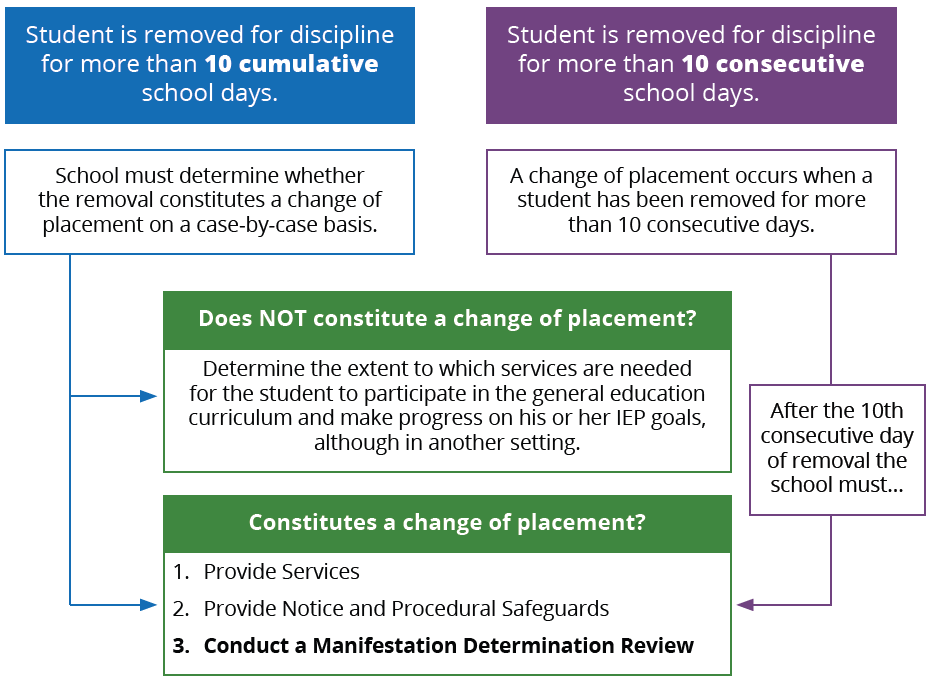
What to Do When the Removal Constitutes a Change in Placement
- PROVIDE SERVICES: The student must be provided educational services (as determined by the ARD committee and documented in an IEP or IEP amendment) to participate in the general education curriculum, although in another setting, and progress toward meeting IEP goals.
- PROVIDE NOTICE and PROCEDURAL SAFEGUARDS: Communicating with parents is a crucial aspect of implementing IDEA's discipline procedures. On the date when the decision is made to remove a student, constituting a change of placement, due to a violation of a code of student conduct, the LEA must notify the parent of that decision and provide the parent the procedural safeguards notice.
- CONDUCT A MANIFESTATION DETERMINATION REVIEW (MDR): The LEA must conduct an MDR within 10 school days of the decision to change a student’s placement. The parent, LEA, and relevant members of the student's ARD committee (as determined by the parent and the LEA) meet and review all relevant information to determine if the conduct in question was caused by or had a direct and substantial relationship to, the student's disability, or if the conduct in question was the direct result of the LEA’s failure to implement the IEP.
For additional guidance on change in placement please see section C in Questions and Answers:
Addressing The Needs Of Children With Disabilities and IDEA’s Discipline Provisions (OSERS, 2022).