Manifestation Determination Review (MDR)

When a student with a disability faces a change in placement as a result of a removal, the LEA must conduct an MDR with members of the ARD committee, including the parent. An MDR is a process in which the ARD committee reviews all corresponding data and the relationship between a student's disability and the behavior subject to the disciplinary action. The team must look at a range of information, including:
- The student’s evaluation, IEP, BIP, and placement
- All relevant information in the student’s file
- Observations of the student by teachers and others
- Any further relevant information supplied by the parent
MDR Questions
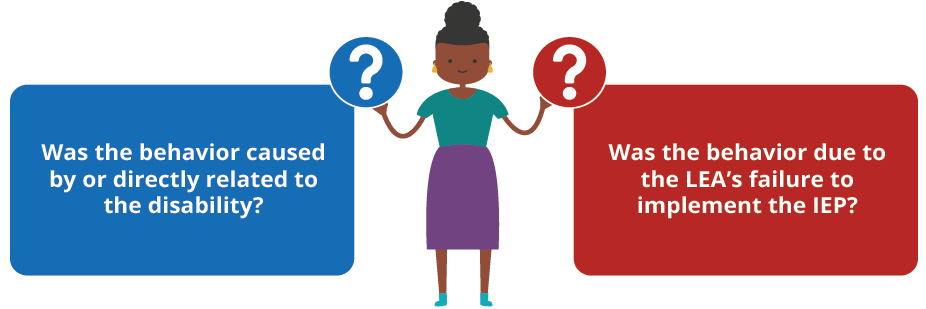
The ARD committee members will then use this information to answer two questions:
- Was the behavior caused by or directly related to the disability?
- Was the behavior due to the LEA's failure to implement the IEP?
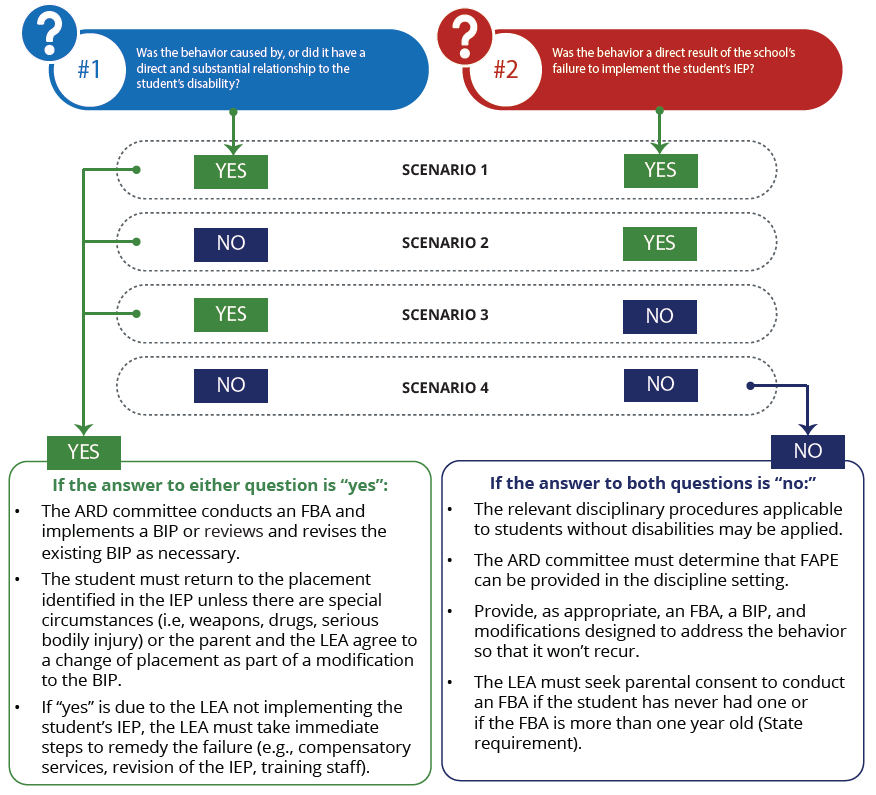
MDR Steps and Scenarios
The following graphic details the MDR steps and the four scenarios that may occur during the process.
For additional guidance on manifestation determination reviews please see section F in Questions and Answers: Addressing The Needs Of Children With Disabilities and IDEA’s Discipline Provisions (OSERS, 2022).
Special Circumstances
Special circumstances apply when the behavior in question involves weapons, drugs, or serious bodily injury. In this case, school personnel may remove the student to an IAES/DAEP to provide FAPE for up to 45 days without regard to whether the behavior is a manifestation of the student’s disability.
Drugs:
- The special circumstance related to drugs is when the student knowingly possesses or uses illegal drugs or sells or solicits the sale of a controlled substance, while at school, on school premises, or at a school function. IDEA defines an “ILLEGAL DRUG” as a controlled substance but does not include a controlled substance that is “legally possessed or used under the supervision of a licensed healthcare professional.” A “CONTROLLED SUBSTANCE means a drug or other substance identified under schedules I, II, III, IV, or V in section 202(c) of the CONTROLLED SUBSTANCE ACT.
Weapon(s):
- The special circumstance for weapons involves carrying or possessing a weapon at school, on school premises, or at a school function. The IDEA adopts the definition of “WEAPON” provided in the U.S. CRIMINAL CODE. This provision defines the term “dangerous weapon” as “a weapon, device, instrument, material, or substance, animate or inanimate, that is used for, or is readily capable of, causing death or serious bodily injury, except that such term does not include a pocketknife with a blade of fewer than 2 1/2 inches in length.”
Serious Bodily Injury:
- The special circumstance for serious bodily injury occurs when the student has inflicted serious bodily injury upon another person while at school, on school premises, or at a school function. The term “serious bodily injury” means bodily injury which involves: (A) a substantial risk of death; (B) extreme physical pain; (C) protracted and obvious disfigurement; or (D) protracted loss or impairment of the function of a bodily member, organ, or mental faculty.
- The 89th Texas Legislative Session (HB 2) added new requirements under TEC §29.010(a‑1) related to the state’s monitoring system for special education. Under this provision, the agency may require a school district to obtain specialized technical assistance when a documented noncompliance issue exists or when data indicate that such support is necessary. This includes situations such as incidents involving injury to staff or students caused by a student receiving special education services, or data reflecting an excessive number of restraints involving students receiving special education services.
When placing a student in an IAES due to special circumstances, follow the same procedures for when a student is removed for more than 10 consecutive school days, including providing services, providing timely notice and procedural safeguards to the parents, and conducting an MDR.
For additional guidance on special circumstances please see section E in Questions and Answers: Addressing The Needs Of Children With Disabilities and IDEA’s Discipline Provisions (OSERS, 2022).