Grading Rubric for Students with Complex Access Needs: Classroom Scenarios

These grading rubric scenarios use the Sample Grading Rubric for Students with Complex Access Needs and demonstrates how to:
- identify prerequisite skill access points to TEKS
- provide instruction that integrates individual accommodations and modifications
- pre-plan individual supports
- use task analysis to determine individual student mastery of an assignment or activity
Using the Rubrics
As a reminder, educators may find this grading rubric most useful for students who are accessing the curriculum (TEKS) at prerequisite levels and routinely participate in alternate or non-traditional methods of assessment. These students may be in the process of developing a functional and consistent mode of communication (e.g., currently non-verbal, uses very limited non-symbolic communication) and require individualized supports (e.g., modifications, task analysis, direct instruction, assistive technologies, first/then charts, tactile schedules, social narratives) and ongoing adult assistance (e.g., prompting, cueing, physical assist) to participate in on-topic academic exchanges.
Additionally, this grading rubric can be helpful for students who are able to complete part of a task independently but require scaffolded supports for certain steps within the task.
This grading rubric aligns with the Rubric of Effective Practices for Students with Significant Cognitive Disabilities Quality Indicator II: Effective Teams.
Related Content
Significant Cognitive Disabilities, Instruction
Sample Grading Rubric for Students with Complex Access Needs

Significant Cognitive Disabilities
Teamwork and Transitions
Significant Cognitive Disabilities, Instruction
September Monthly Instructional Guide for Students with Complex Access Needs
ARD/IEP Supports, Behavior, Significant Cognitive Disabilities, Autism, Evaluation
Data Collection: Task Analysis
Significant Cognitive Disabilities, Instruction
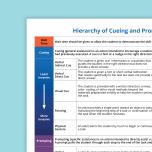
Hierarchy of Cueing and Prompting

Significant Cognitive Disabilities, Instruction