ARD Committee Manager Training

Note: At this time, the proposed amendments to 19 Texas Administrative Code (TAC) §89.1050 and 1055 have not been adopted and are still subject to the rulemaking process. Because the rule has not been finalized, the Texas Education Agency (TEA) is unable to provide guidance or interpretations regarding how the proposed changes would be implemented.
TEA's guidance is based on current law and adopted rules. If the proposed amendment is adopted, TEA will develop and disseminate guidance and technical assistance as appropriate to support local educational agencies (LEAs), education service centers (ESCs), families, and other stakeholders in understanding and implementing the adopted requirements.
Until any amendment is officially adopted and becomes effective, LEAs should continue to follow the requirements currently in effect.
Due to this information and the extensive connection to the proposed TAC amendments, the 26-27 ARD Committee Manager Training TEA Learn course will be relaunched within a few weeks.
We appreciate your patience and understanding during this time.
This course provides best practices for ARD committee managers for local education agencies (LEAs) that choose to use this model. Other common job titles for this position include ARD Committee Facilitator, ARD Committee Chair, and Child-Centered Process Liaison. Position titles may vary from one LEA to another.
An ARD committee manager is a staff member who facilitates or leads ARD committee meetings and helps meet local, state, and federal guidelines for students being considered for or receiving special education and related services.
An ARD committee manager's roles and responsibilities typically include:
- Scheduling and mailing notices for ARD committee meetings.
- Gathering relevant student data, such as, grades, attendance, behavior reports, progress monitoring data, universal screening results, previous and current evaluation reports.
- Preparing and finalizing required ARD committee paperwork.
- Facilitating the ARD committee meeting.
- Sending completed Individualized Education Program (IEP) documents to the parents or guardians and archiving in accordance with LEA procedures.
- Supporting families and school personnel with special education questions.
- Assisting classroom teachers with understanding and documenting the receipt of students’ IEP paperwork.
- Complying with requirements established by federal and state law, state board of education (SBOE) rules, local board policies, and special education operating procedures.
This course is intended to provide information, guidance, and best practice for successfully achieving these expectations.
Related Resource
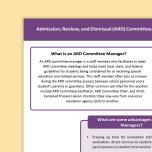
ARD/IEP Supports
ARD Committee Manager Quick Guide
ARD/IEP Supports