- Hi, Administrators. Welcome to this administrator video series from the Texas Complex Access Network, or TxCAN. This video addresses how leaders can provide effective classroom support to teachers. (bright music) Many administrators struggle with providing guidance and leadership to their educational staff who support students with significant cognitive disabilities.
This is a small and diverse student population, and many administrators have had limited training or experience working directly with students with more complex access needs. You may have wondered; how do I hire quality educators for this population? What should I look for when I visit classrooms to ensure our program appropriately serves students with significant cognitive disabilities? What does high-quality, rigorous instruction look like for this population?
How can I provide leadership and guidance when participating in ARD committee meetings? In this video, we will highlight resources that will answer these questions and make it easier to support these teachers. Let's begin by addressing your hiring concerns. An evidence-based program requires competent and trained staff.
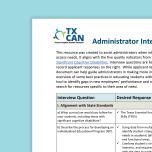
To assist you, TxCAN has created a hiring resource document to support you during the interview process. Interview questions are provided along with desired responses to listen for from the applicant. While we acknowledge most applicant responses will not address all the points TxCAN provides, this resource supports you in making more informed hiring decisions. It also provides an overview of many best practices for this student population.
Additionally, after hiring, you can use this tool to address knowledge gaps and refer the new employee to specific TxCAN trainings, such as "Building a Foundation for Supporting Students "with Significant Cognitive Disabilities" and "A Step Toward IEP Quality and Rigor." These two courses are online at no cost to educators and were developed with the guidance of the Texas Education Agency. "Building a Foundation" and "A Step Toward IEP" quality trainings are absolutely essential for all educators supporting students with complex access needs. In fact, it is recommended that every educator supporting this population complete both trainings.
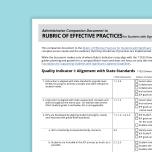
Let me share with you how both courses can assist you with providing leadership and guidance. The first course, "Building a Foundation," lays the groundwork for evidence-based instructional practices and will provide you with those critical look for's during classroom visits. As teachers move through the course, they complete the TxCAN Rubric of Effective Practices, marking each indicator as evident or non-evident. To assist you in providing guidance to your staff, TxCAN has also created an Administrator Companion document for the rubric.
The Companion document provides you with a list of evidence you should see during classroom practice and team collaboration when each indicator is implemented with Fidelity. As the administrator, you might ask that staff submit their completed rubric to you after the course. Then you can refer to their rubric during classroom visits and use the Companion document to provide suggestions and positive feedback. Over the year, you can continue to utilize the rubric to document growth.
An important note. The rubric does make note of where indicators of effective practices may align with the T-Test dimensions. However, you should not use this tool as the sole source of evidence for determining teacher performance. Instead, it guides planning and growth for the campus or district team as the focus is not solely on the role of the teacher.
You may find that the rubric reveals a need for increased classroom supports or better lesson alignment with state standards or it could indicate a need for more planning time, team collaboration, data collection or professional development. The second course, "A Step Toward IEP Quality and Rigor," covers three critical sections of the individualized education program, or IEP, that educators are most responsible for. The present levels of academic achievement and functional performance, or the PLAAFP, goals and objectives and progress monitoring methods. Many examples are shared within the course to enhance understanding of each component.
This course also contains a rubric which enables the educator to reflect on his or her own practice to ensure each critical component is included in the IEP. This course and rubric will guide educators and teams in creating high quality IEPs that lead to rigorous instruction and improved student outcomes. After completing the IEP quality and rigor course, one educator remarked, "I was so proud today after the ARD meeting "when my director approached me "and stated how good my PLAAFP for the student was. "I explained to him how I used the rubric "to help me as a guide "when I was preparing for the student's ARD.
"I am so proud of myself." Many administrators are using the rubric as a review tool in preparation for ARD committee meetings. Others are using the rubric during folder reviews to identify systemic areas of weakness that can be addressed through professional development. For more information on both courses, talk to your regional ESC TxCAN specialist.
Here's a final thought as we close. This network is built on the premise that poor academic performance and progress by students with significant cognitive disabilities reflects a lack of sufficient instructional supports and strategies rather than the student's abilities. Research demonstrates that when given appropriate supports and instruction, the significance of the cognitive disability is reduced. Administrators, we need to you to provide guidance and support for your staff to effectively address the needs of each and every student.
And we're here to help. (bright music)