Instructional Support Planning Meetings
(bright music) - When teams first begin to include a student with complex access needs in a general education classroom, I think that the number one variable that will affect their success or their feeling of failure is whether or not they have regular common planning time together. And by regular, I mean once a week. So once a week, when the team comes together, and actually I'm gonna talk about elementary school right now. So when I say team, I mean the general ed teacher, special ed teacher, speech language pathologist, occupational therapist, para educator, paraprofessional. If one is working with the student, those folks come together for about an hour once a week, and they ask the question, "What is going to be taught next week in this classroom? And what supports does our new student need in order to participate actively in everything that we're going to be doing?" The planning process that includes that question about participation is really a new way for many people to communicate and to plan. It's a new experience to put out to a group of people, "Here's what I'm thinking of teaching next week." And then to invite some brainstorming from a group of people about how this new student can participate. When people first engage in this planning process, they will quite honestly not finish planning for all the core academic subjects that are going to be taught during a typical day, during a typical week. And that's okay. As time goes on, as the second week of school rolls around, and the third week and the fourth week, teams not only become more comfortable with the process and more proficient at coming up with good strategies for the students' participation, but they also become more efficient in the use of their time.
In this video, Cheryl Jorgensen, an expert on inclusion for students with the most complex access needs, discusses how Instructional Support Planning meetings run more efficiently over time. This video aligns with the Rubric of Effective Practices Quality Indicator II: Effective Teams and Quality Indicator IV: Differentiated Instruction.
Related Content

Significant Cognitive Disabilities, Inclusion, Instruction
Supports for Participation for Students with Complex Access Needs

Inclusion, Significant Cognitive Disabilities
Inclusionary Coaching Guide For Students with Complex Access Needs
Significant Cognitive Disabilities, Inclusion
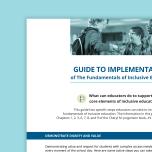
Guide to the Implementation of The Fundamentals of Inclusive Education for Students with Complex Access Needs

Significant Cognitive Disabilities, Inclusion
