ARD Committee Meeting Documentation

ARD Committee Meeting Documentation
- Meeting Participants
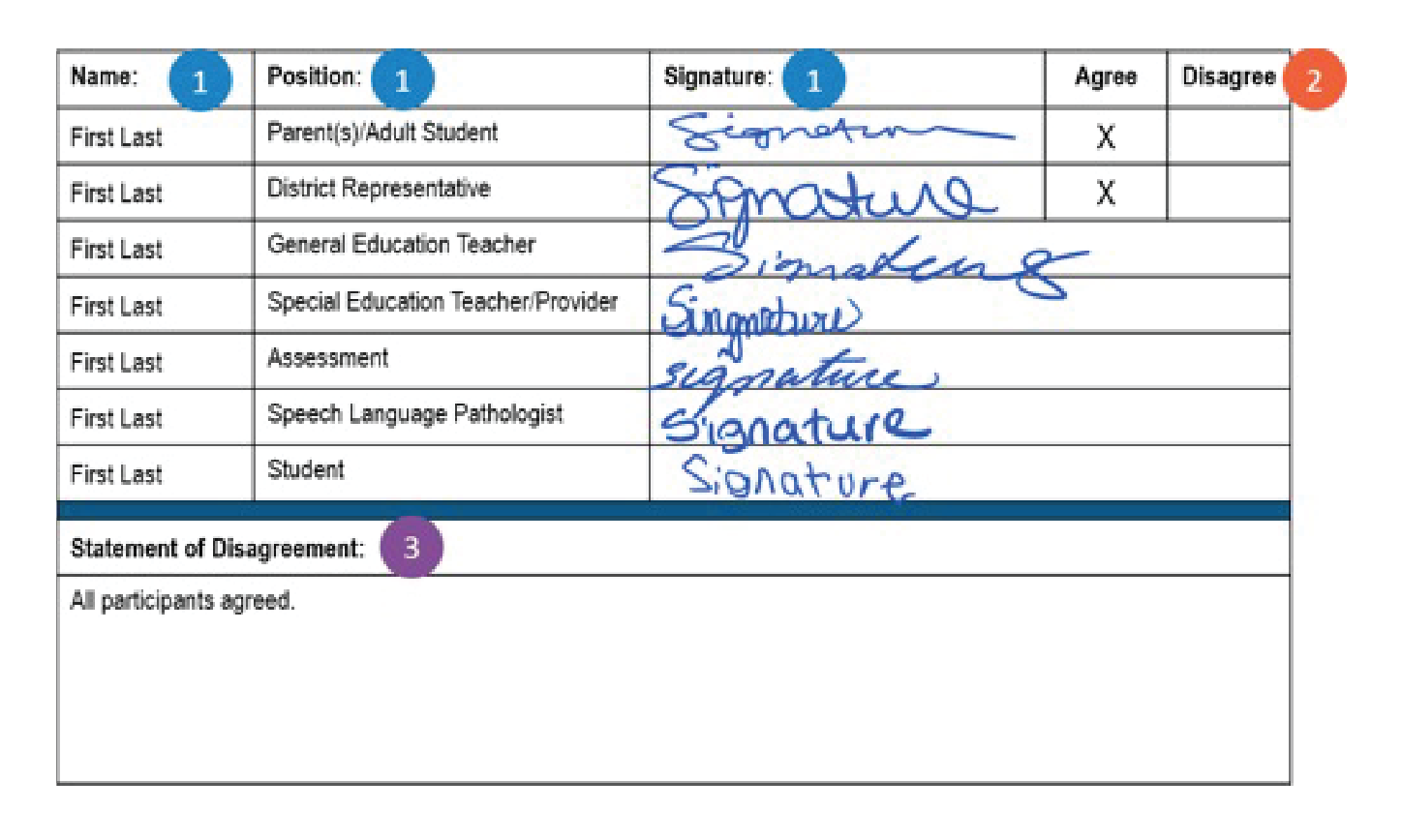
The IEP must include the name, position/title, and signature of each member PARTICIPATING in the meeting. - Indication of Agreement or Disagreement
The IEP must indicate whether the student's parents, the adult student, if applicable, and the district representative/administrator AGREED or DISAGREED with the decisions of the ARD committee. - Statement of Disagreement
If the IEP was not developed by agreement of all ARD committee members, the IEP MUST INCLUDE a written statement of the basis of the disagreement. Each ARD committee member who disagrees with the IEP is entitled to include his or her statement of disagreement.
NOTE
TEC §29.0031 specifies that someone with specific knowledge of the reading process, dyslexia and related disorders, and dyslexia instruction must serve on the ARD committee when eligibility or continued eligibility for dyslexia will be discussed. This person must sign a document describing the member's participation in the evaluation of a student described by that subsection and any resulting IEP developed for the student.
What happens when parents do not agree with the IEP?
There are times when parents may not agree with the recommendations made by the other members of the ARD committee about the student’s education. In these situations, parents must be offered an opportunity to recess and reconvene the ARD committee meeting within 10 school days (unless mutually agreed otherwise).
During the recess the ARD committee members must:
- consider alternatives,
- gather additional data,
- prepare further documentation, and/or
- obtain additional resource persons who may assist the ARD committee in reaching mutual agreement.
If a recess is implemented, and if the ARD committee still cannot reach mutual agreement, the LEA must implement the IEP that it has determined to be appropriate for the child. Under the law, parents have the right to challenge decisions about their child's eligibility, evaluation, placement, and the services that the school provides to the child. If parents disagree with the school's actions, or refusal to act, they have the right to pursue several dispute resolution options. All options can be reviewed on the TEA Special Education Dispute Resolution Processes webpage including accessing the Special Education Dispute Resolution Handbook.
Final Decisions
ARD Committee Decisions
The IEP must accurately document the decisions of the ARD committee concerning issues discussed at the meeting. Decisions documented in other sections of the IEP do not have to be restated in the deliberations section.
A “WRITTEN STATEMENT" must document the decisions of the ARD committee with respect to issues discussed at each ARD committee meeting. The written statement must also include: the date of the meeting; the name, position, and signature of each member participating in the meeting; and an indication of whether the child’s parents, the adult student, if applicable, and the administrator agreed or disagreed with the decisions of the ARD committee.

Copy of the IEP
Schools must PROVIDE PARENTS A COPY of the IEP at no cost. For parents who do not speak English, and their native language is Spanish, the school must provide a written copy or audio recording of the IEP translated into Spanish. For languages other than Spanish, the school is required to make a good faith effort to provide a written copy or audio recording of the IEP translated into the parents’ native language.
NOTE
- A written translation means that all of the text is translated in written form.
- An audio recording of an ARD committee meeting where an interpreter provided translation of the meeting is acceptable as long as all of the content in the IEP is orally translated and recorded.
IEP Amendment Without a Meeting
If changes need to be made to an IEP after the annual ARD committee meeting, the parent and the school MAY AGREE not to convene an ARD committee meeting to make changes, and instead may develop a written document to amend or modify the current IEP. If any changes are made to the IEP in this manner, the school must ensure that the ARD committee, including the parent, is informed of these changes.

An IEP may be amended without an ARD meeting when there are proposed changes to:
- PLAAFP (Present Level of Academic Achievement and Functional Performance)
- Goals and Objectives/Benchmarks
- State Assessments
- Progress Measurement
- Accommodations
- Transportation

An IEP amendment process may NOT be used for:
- Eligibility determinations
- Changes of placement
- Manifestation determination reviews
- Initial, or Annual, or Dismissal ARD meeting