Intensity of Services Special Education Funding Model Resources
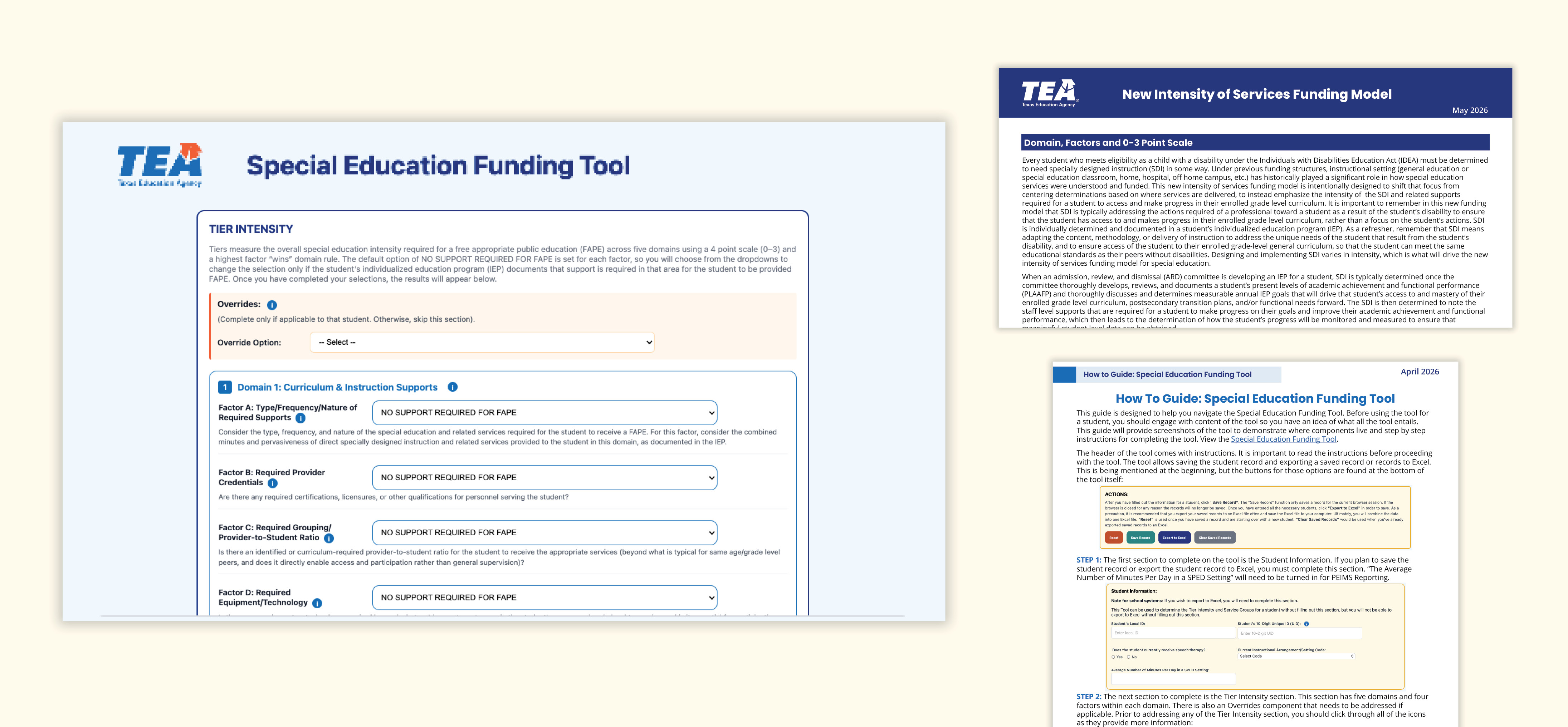
Understanding the Intensity of Services Funding Model
Intensity Tiers
To determine the tiers of intensity in the new intensity of services funding model, there are 5 domains for which an intensity level of support must be determined based on ARD committee decisions documented in a student’s individualized education programs (IEPs).
Determining levels of support and the intensity tier will be measured across 5 required domains:
- Curriculum and Instruction,
- Behavior,
- Communication,
- Independent Functioning, and
- Personal Care/Health.
Each domain is evaluated independently using IEP documentation and considers 4 key factors:
- the type, nature, and frequency of services;
- whether a specialized provider is required;
- whether a specific staff to student ratio is necessary; and
- whether specialized equipment or technology is needed.
Domains are scored on a four point (0-3) scale, with the highest factor score determining the overall domain intensity.
Service Groups
In addition to intensity tiers are service groups. Service groups are designed to recognize that, beyond a base level of special education funding determined through the intensity tiers, some students require additional, measurable resources to implement their IEPs. There are five service groups in the new model. Service groups will generate additional funding.
Every student who meets eligibility as a child with a disability under the Individuals with Disabilities Education Act (IDEA) must be determined to need specially designed instruction (SDI) in some way. Under previous funding structures, instructional setting (e.g., general education or special education classroom, home, hospital, off home campus) has historically played a significant role in how special education services were understood and funded. This new intensity of services funding model is intentionally designed to shift that focus from centering determinations based on where services are delivered, to instead emphasize the intensity of the SDI and related supports required for a student to access and make progress in their enrolled grade level curriculum.
Resources and Guidance for Implementation
TEA has created the following resources to support school systems in determining the tier of intensity and service groups for their students. TEA also disseminated a To the Administrator Addressed (TAA) Letter on April 16, 2026, that should be used to support school systems with this new process and model.
Special Education Funding Tool
The Special Education Funding Tool is designed to provide an interactive mechanism for Texas school systems to analyze a student’s individualized education program (IEP) and crosswalk those documented services into the new model. This tool will assist school systems in determining an intensity of service tier and service group for each of their students receiving special education services. Users should review each domain within the tool and use the associated dropdown menus for each factor to determine the student’s intensity tier. Users must also indicate whether the student also requires one or more service groups. Information collected using the tool’s export feature can be used in assisting school systems with their required PEIMS data collections.

State Guidance, ARD/IEP Supports
Special Education Funding Tool

State Guidance, ARD/IEP Supports
How to Guide: Special Education Funding Tool
New Intensity of Services Funding Model Framework
The New Intensity of Services Funding Model Framework is a PDF copy of the Special Education Funding Tool. The framework is set up to provide the user with information about the intensity tiers and the service groups. The framework walks through the entirety of the tool, providing a laid-out format of what is in dropdown boxes and popups on the tool. This easy-to-use framework can be used as a companion to the Special Education Funding Tool or as a stand-alone tool.

State Guidance, ARD/IEP Supports
New Intensity of Services Funding Model Framework
Related Services in Special Education - Questions and Answers
This document answers questions regarding related services provided through special education. The Individuals with Disabilities Education Act (IDEA) and federal regulations at 34 Code of Federal Regulations (CFR) §300.8 define child with a disability as having an eligible disability and, by reason thereof, needing special education and related services. While not every student requiring special education services will also require related services to access a free appropriate public education (FAPE), a student found to only need related services cannot be a child with a disability under the IDEA.

ARD/IEP Supports, Evaluation, State Guidance
Related Services in Special Education - Questions and Answers
Description of Updates Since April 16, 2026 Publication
We have made a number of clarifying edits and updates since the tool’s and framework’s original publication date on April 16, 2026. These updates do not substantially change the tool or funding framework but were made based on multiple requests for clarification.
June 2026 Updates:
- Framework PDF
- Overrides were added to the beginning of the document and will remain after the tiers of intensity.
- The overall language has been updated to read: “One or more of the following is true” rather than “The majority of the following is true”
- Direct SDI must be present in at least one of the domains and therefore is no longer an optional choice for any of the domains.
- Two overrides have been added:
- If the child is 0 through 2 years of age, is deaf or hard of hearing, deafblind, or has a visual impairment, and receives services at home or through center-based care, the assigned tier is Tier 1. School system providing services is not the ECI provider.
- If the child is 3 through 5 years (not enrolled in kindergarten) of age, and services are provided by the school system in which the child is enrolled but not on a school campus, the assigned tier is Tier 1.
- In Domain 1, Factor A, “Minimum” now reads “For a student identified with dyslexia, the student's IEP does not require dyslexia instruction through an evidence-based program.”
- In Domain 1, Factor B, Dyslexia Handbook has been removed from the “Moderate” column.
- In Domain 1, Factor B, the first bullet in the “Significant” column has been update to the following: “a licensed dyslexia therapist; someone who has received training through an International Multisensory Structured Learning Education Council-accredited training center at the teaching or therapy level; or someone who has received certification or training from the following programs or providers: Academic Language Therapy Association, the International Dyslexia Association, the Orton Gillingham Academy, and Wilson Language Training.”
- In Domain 2, Factor B, the third bullet has been removed from the “Moderate” column.
- In Domain 2, Factor B, the first bullet in the “Significant” column has been updated with the following language added: “Highly specialized behavioral expertise from a school psychologist, board certified behavior analyst (BCBA), or behavior specialist employed by the school system in that role is essential for safe and effective implementation (e.g., intensive function-based intervention requiring advanced judgement, frequent plan redesign, complex coordination).”
- In the Service Group 4-5 description, the following as been added: “OR the amount of time per week a student receives their special education and related services at home, at a hospital or other medical facility (including an outpatient facility), or at another facility not operated by the school system in which the student is enrolled, but the services are provided by personnel of the district or open enrollment charter school in which the student is enrolled.”
- In Service Group 4, a second bullet was added with the following language: “The student receives less than 4 hours per week of special education and related services at home, at a hospital or other medical facility (including an outpatient facility), or at another facility not operated by the school system in which the student is enrolled, but the services are provided by personnel of the district or open enrollment charter school in which the student is enrolled.”
- In Service Group 4, the following has been removed from the last sentence: “while not needing continuous 1:1 assistance throughout the entire day.”
- In Service Group 5, a second bullet was added with the following language: “The student receives 4 or more hours per week of special education and related services at home, at a hospital or other medical facility (including an outpatient facility), or at another facility not operated by the school system in which the student is enrolled, but the services are provided by personnel of the district or open enrollment charter school in which the student is enrolled."
- In Service Group 5, the following has been removed from the last sentence: “across nearly the full instructional day.”
May 2026 Updates:
- The first option in the dropdowns (options) in all domains and factors was changed from “No Support Required for FAPE” to “No Support Required or Documented in IEP”. This has also been updated in the in the table headers. In this section of the table, “OR No documentation or evidence in the IEP” was added and duplicative language was taken out. This update was made to provide a less absolute declaration that support is not required for FAPE when the reviewer may just not be able to find documentation in the IEP to support a minimum, moderate, or significant rating. (Update made May 7, 2026)
- In Domain 1, Factor A, the first bullet under “Moderate” is now: “For a student receiving dyslexia instruction, the IEP requires the instruction to be delivered through an evidence-based program with fidelity as required by a program adopted under TEC §38.003. At least 1 academic goal or at least one functional goal directly tied to academic performance is present.” (Update made May 7, 2026)
- In Domain 1, Factor B, the first bullets under “Moderate” and “Significant” have been modified to refer more directly to what would be in the student’s IEP for documentation for that rating. (Update made May 7, 2026)
- In Domain 1, Factor C, the second bullet under “Moderate” has been updated to delete the term “regular small group” to instead focus solely on the planned reduced ratio described in the IEP. (Update made May 7, 2026)
- In Domain 2, Factor A, the reference to “functional goals related to behavior” has been deleted in favor of simply “behavior goal(s).” (Update made May 7, 2026)
- In the “Service Groups” section of the online “Tool”, in “Service Groups 1-3”, when a user clicks “yes” for “Does the student receive related services?” there’s a new radio button that says, “Less than 180 minutes per six-week period”. If this option is the only one selected in this section, the result will be “No Service Groups 1-3”. (Update made May 1, 2026)
Frequently Asked Questions
This Frequently Asked Questions (FAQ) section is designed to support Texas school systems in understanding the new funding system and in using the Special Education Funding Tool. As school systems begin using the tool and new questions arise, this FAQ will be reviewed and updated on an ongoing basis to ensure it remains accurate, helpful, and responsive to user needs.
Additional resources will be added frequently so make sure to check the full section list for all available resources.
1. Policy and Funding Model Basics
1.1 Why is the state funding model for students receiving special education and related services changing? (4/16/26)
House Bill (HB) 2/Senate Bill (SB) 568 passed during the 89th Regular Session, which significantly shifted how the state will fund special education. The state is now transitioning from an instructional arrangement/setting-based funding model to a service intensity model, irrespective of setting. The service intensity model will more efficiently analyze and target student needs, as these are documented in their individualized education programs (IEPs), so that state funding is distributed based on the intensity of individual needs rather than the classroom or setting.
1.2 What is the new funding system? (4/16/26)
The new funding system is based on the determination of a tier of intensity for an individual student, which is inherently based on the services documented in the student’s IEP as necessary for the student to receive a free appropriate public education (FAPE). Additionally, the system accounts for service groups, which are add-on ancillary amounts that reflect extra services that are not directly built into the foundational tier determinations. There are eight tiers of intensity and five service groups.
1.3 What is the difference between the tiered funding system and the current instructional arrangement system? (4/16/26)
The primary difference is that the new funding system is targeting the student’s special education service needs unrelated to the setting in which they are receiving them. Instructional arrangements are currently calculated based on the percentage of the school day a student spends in a special education setting, which does not always reflect the intensity of the special education services or the extent of services received by that student. The new tiered funding system will place a student within a tier based on how intensive their special education services are, as determined by the type, frequency and nature of those services; whether any particular qualifications are necessary for staff who serve the student; whether any required provider-to-student ratios are required when implementing those special education services; and whether any equipment or technology is required for that student to access the educational environment.
2. Financial Impact and Transition Timeline
2.1 What impact will the new funding model have on my district’s special education funds? (5/7/26)
In the tiers of intensity framework, the lowest weight will be applied to students who are determined to be Tier 1, and the highest weight will be applied to students who are determined to be Tier 8. The law dictates that the first tier is for those students who receive speech therapy as their only instructional special education service, and tier 8 is reserved for students who are placed in residential placement programs by their admission, review, and dismissal (ARD) committee. The commissioner must adopt rules to determine how students are placed in the remaining tiers. Within service groups, which must also be determined by commissioner rules, a lower dollar amount will be applied to service group 1 and the highest will be applied to service group 5.
As opposed to instructional arrangement/setting codes, where the Texas Education Code (TEC) and the Student Attendance Accounting Handbook (SAAH) define weights and contact hour multipliers and factors to estimate special education funding locally, the transition to the intensity of services model will require some adjustments. For example, the commissioner is required to submit recommendations for weights and dollar amounts to the Legislative Budget Board (LBB) by December 1 of each even-numbered year ahead of the next biennium.
The 2026-2027 school year will be a year of transition, and TEA will need to receive data before any estimates around weights and dollar amounts can be given. However, for the 2026-2027 school year ONLY, school systems will receive at least what they would receive under the instructional arrangement/setting system, meaning that the formula used to calculate the funding allotment using the instructional arrangement codes will continue to be used for 2026-2027 school year, but will no longer be used for the 2027-2028 school year and beyond
2.2 Will we receive less money this school year based on the tiered funding level? (5/7/26)
While it is possible for a school system to receive less state special education funding once the new funding system is implemented, TEA has determined for this transition year only that school systems will receive at least the funding they would have received under the formulas of the instructional arrangement/setting system. The 2027-2028 school year, however, will run under only the intensity of services model.
2.3 ** Updated** When will we need to start using the tiered funding and when does the instructional arrangement go away? (6/17/26)
In order for TEA to have a full year’s worth of PEIMS data during this transition year of both instructional arrangements and the new tiers and service groups, TEA has established the following requirements:
- Continue Instructional Arrangement/Setting Reporting: As in typical years, any instructional arrangement/setting codes indicated in the PEIMS Summer submission for a student will be carried over into the 2026-2027 SY until an end date is entered due to a change in the student’s individualized education program (IEP) that warrants a new instructional arrangement/setting code. During the 2026-2027 SY, when an IEP is revised or developed that determines necessary special education and related services that would change the student’s instructional arrangement/setting code as those are currently calculated, the previous instructional arrangement/setting code will be reflected with an end date and the revised instructional arrangement/setting code will be entered, along with a new begin date.
- By the first PEIMS Attendance Submission reporting period (1st Six Weeks Attendance), due October 8, 2026, each school system is expected to review IEPs that are in place as of the first day of the 2026-2027 SY for at least 50 percent of their students receiving special education services and enter:
- the student’s tier of intensity,
- any applicable service group(s), and
- the average number of minutes per instructional day the student spends in a special education setting.
- By the second PEIMS Attendance Submission reporting period (2nd Six Weeks Attendance), due December 3, 2026, school systems must report data regarding a student’s eligible days present in the tier of intensity, applicable service group(s), and the average number of minutes per instructional day the student spends in a special education setting for students whose data was not included in the first Attendance Submission. The begin date for these students will still be the first day of the school year, unless an Admission, Review, and Dismissal (ARD) committee meeting results in a revision to the student’s IEP services that affects the tier of intensity, service group(s), or minutes in a special education setting. By the second PEIMS Attendance Submission, eligible days present will be reported for both the instructional arrangement/setting and the tier of intensity for all students served in special education and who are eligible for funding.
- School systems report eligible days present for the instructional arrangement/setting and the tier of intensity, service group(s), and average number of minutes per instructional day the student spends in a special education setting for all reporting periods in the PEIMS Summer Submission (even for those students whose tier of intensity data was not reported in the first PEIMS Attendance Submission).
These data elements will be reported with a begin date of the first day of the school year. Once entered, these values, including the instructional arrangement/setting code, will remain in place with no end date unless the student’s specially designed instruction (SDI), as documented in the IEP, is revised.
Additionally, if school systems determine that clarifications need to be made or data errors need to be corrected after the first or subsequent PEIMS Attendance Submissions, they are able to make those corrections in the PEIMS Summer Submission due in June (first submission) and July (Summer Resubmission) 2027.
3. Funding Structure (How It Works)
3.1 What are tiers in the new funding model? (4/16/26)
There are eight tiers of intensity. The first tier, which is required by statute, is for students who receive speech therapy as their only instructional service. The eighth tier, which is also required by statute, is for students whose admission, review, and dismissal (ARD) committees place in a residential placement program. The remaining tiers will be determined based on the special education services that are required by a student in order to receive FAPE. Those services must be documented in the student’s IEP. Using the tools provided by TEA (more information provided below), a school system will determine the level of support needed by the student in five domains, issue that level of support a domain score, and then add those up to reach a composite score. The composite score is then matched to a scale that will list the applicable tier of intensity.
3.2 ** Updated** What are service groups in the new funding model? (6/17/26)
Service groups are add-on funding for services that are known cost drivers for educating students with disabilities. There are five service groups, with service groups 1 through 3 grouped together and then service groups 4 and 5 grouped together. Service groups 1 through 3 describe the extent of related services that a student receives. Service groups 4 and 5 involve two different scenarios: 1) students are assigned a 1:1 provider-to-student ratio for at least 50% of the student’s instructional day; or 2) students receive their special education and related services at home, a hospital or other medical facility (including an outpatient facility), or a facility not operated by the district/school but district/school personnel provide regularly scheduled instruction or services.
The extent of related services for service groups 1-3 are primarily calculated by the minutes provided by the total number of related services per six-week period. However, if a student receives special transportation or parent counseling and training as a related service, either or both of these related services make the student eligible for service group 1, regardless of the minutes per six-week period of the others. This is because calculating minutes per six-week period for those two related services did not seem appropriate given how they are typically provided, budgeted, and/or reimbursed.
3.3 ** Updated** What documentation is needed to assign tiers and service groups in the new funding system? (6/17/26)
In order to assign tiers and service groups, the special education services that drive those tiers and service groups must be evident and documented in a student’s IEP. The system is designed to reflect only those services required for a student to receive FAPE, as determined by their ARD committee and documented in the IEP. While reviewing the domain descriptions, you may think that a particular description “sounds” like the student whose IEP you are reviewing, but, unless you can find it documented in the student’s IEP as a service or specially designed instruction required for the student to receive FAPE, that description or rating cannot be chosen.
That said, the intensity of services model is an entirely new way of funding special education. It may take some time for ARD committees to adjust to new ways of documenting a student’s intensity of services in relation to the ARD committee’s responsibility to offer FAPE to the student. However, a necessary goal of the intensity of services model is to establish calibration in the system, which means that every reviewer of the same IEP should arrive at the same tier and service group result. Therefore, even if a reviewer knows something to be true about a student when going through the exercise of determining tiers and service groups, it cannot be determined to be true unless there is evidence in the IEP showing that it is true and required for FAPE.
Note that when you begin using the tool, the default for all factors is “NO SUPPORT REQUIRED OR DOCUMENTED IN IEP.” If the practitioner completing the tool cannot locate any information within the IEP that would support a minimal, moderate, or significant rating, then the “NO SUPPORT REQUIRED OR DOCUMENTED” will remain the choice. When the practitioner is uncertain between two ratings, the practitioner will choose the lower rating of the two.
4. Data Collection and Reporting (PEIMS/TSDS)
4.1 ** Updated** What are all of the data elements – both new and old – that we have to collect and submit around special education funding for 2026-2027 and beyond for PEIMS? (6/17/26)
Instructional Arrangement/Setting Code: School systems will continue to collect and submit this information according to the requirements of the Student Attendance Accounting Handbook for the 2026-2027 school year. Beginning with the 2027-2028 school year, instructional arrangement/setting codes will no longer have to be collected. TWEDS - Descriptor (C025)
Tier of Intensity: Beginning with 2026-2027 school year, the tier of intensity (1-8) must also be reported for each student. That will continue to be collected as we fully transition into this system. TWEDS - Descriptor (C371)
Service Group: If a student is eligible for a service group allotment (either 1-3 or 4-5), that will be collected and reported beginning with the 2026-2027 school year as well. TWEDS - Descriptor (C373)
Minutes in Special Education Setting: TEC 48.051 requires that the time spent in a special education setting and in career and technology programs be proportionately deducted from the regular allotment. The average number of minutes spent each day in a special education classroom/setting will now be a data element collected and reported for this purpose. Note: this data element is NOT the total minutes receiving special education services; it is the average number of minutes spent each day in a special education classroom/setting. TWEDS - Data Elements Details: NumberOfMinutesInSPED (E3162), NumberOfMinutesInSPEDBeginDate (E3163), and NumberOfMinutesInSPEDEndDate (E3164).
***Educational Environment: Note: the collection and reporting of this data element will be postponed until the 2027-2028 school year. Beginning with each student’s annual IEP review in 2027-2028, a new data element called educational environment will be collected and reported. While this is not directly tied to state funding, whether a child receives some or most of their special education and related services in a general education setting or whether they receive those services in some type of specialized placement, educational environment is a required data element that must be reported by the state to the US Department of Education. Whereas TEA interpreted instructional arrangement/setting codes into the required educational environment elements for the Department, this new element will more closely resemble the specific data required by the federal government.
4.2 When can school systems begin inputting these new data elements into their student information systems (SIS)? (5/7/26)
School systems may begin entering the new data elements into their local source systems once those elements are made available by their vendor. Some vendors may allow districts to begin entering the data prior to the 2026–2027 school year but delay publishing the data to TEA until the 2026-2027 Individual Operational Data Store (IODS) opens on August 3, 2026. Regardless of local entry capabilities, the new data elements cannot be published to TEA until the 2026–2027 IODS opens.
4.3 Do all student information system vendors know about the new data element requirements? (5/7/26)
Yes. Vendors were formally notified of the new data elements with the release of the December 1, 2025, version of the Texas Education Data Standards (TEDS). Vendor training on the new elements was conducted on December 4, 2025. A software development kit (SDK) supporting the implementation of these data elements was released to vendors on March 4, 2026.
4.4 How do we calculate minutes per day in a special education setting? What if we have 4-day instructional weeks vs 5-day instructional weeks? What if we have a mix of both? (5/7/26)
The Number of Minutes In SPED indicates the average number of minutes per day that a student receives special education services in a special education classroom or setting, as determined by the admission, review, and dismissal (ARD) Committee.
- This value is the numerator used in calculating the regular program offset.
- The campus’s instructional minutes per day serves as the denominator for the regular program offset.
Four-Day Instructional Week
For school systems operating on a four-day instructional week, report the student’s average daily special education minutes across the four instructional days.
Comparison Example
The table below shows how the same weekly special education minutes are converted to daily averages for a four-day versus five-day instructional week.
| Campus Calendar Days per Week | Instructional Minutes per Day | Instructional Minutes per Week | SPED Minutes per Week | SPED minutes per day |
|---|---|---|---|---|
| 4 | 450 | 1800 | 900 | 900 ÷ 4 = 225 |
| 5 | 360 | 1800 | 900 | 900 ÷ 5 = 180 |
Mixture of Four-Day and Five-Day Weeks
If a school system uses both four-day and five-day instructional weeks, report the SPED minutes per day that correspond to the instructional calendar used for the majority of the school year.
4.5 How do we report minutes per 6-week period if we do not operate on 6-week grading periods or if that is not how the IEP documents services? (5/7/26)
Effective with the 2025-2026 school year, schools now report PEIMS Six Week Attendance Submissions each of the first five six-week periods and then the sixth six-week period (and full-year data) is reported through Summer Submission. For the 2026-2027 school year, the following reflects the due dates for each six-week period:
- First six-weeks due October 8, 2026
- Second six-weeks due December 3, 2026
- Third six-weeks due January 28, 2027
- Fourth six-weeks due March 18, 2027
- Fifth six-weeks due May 13, 2027
- Sixth six-weeks (aka PEIMS Summer First Submission) due June 17, 2027
Each school system has flexibility in structuring its calendar with respect to the start date, end date, number of days in each semester, and number of days in each six-week reporting period.
That said, school systems are familiar with dividing their school year into six-week periods, even if those weeks are not exactly six weeks in length, as that is how attendance and program participation is reported through PEIMS.
Therefore, if the IEP does not document the provision of services in each 6-week period, the person calculating the student’s services for purposes of funding must convert those service minutes to what is received each 6-week period.
5. Using the SPED Funding Tool
5.1 How do I start using the special education funding tool and other resources provided by TEA? (4/16/26)
There are two primary resources a practitioner will want to access as they start learning about this new system. The first is what’s referred to as the special education funding tool. This is an online resource that has the logic of the tier and service group scoring built into it. As the user analyzes an IEP and interacts with the tool by choosing the applicable rating based on the documentation provided in the IEP, the tool will automatically calculate the tier of intensity. Similarly, based on the IEP, the user will determine if the student qualifies for a service group, the tool will automatically calculate what service group(s) is/are applicable to that student.
The tool also allows the user to analyze multiple IEPs, save those tier and service group determinations, and export those saved records to an Excel file. The export to Excel will assist in tracking the information to report to those responsible for entering the tier and service group information into TSDS/PEIMS.
Another helpful resource will be the framework narrative provided in PDF format. This information is also embedded into the tool, but many users may prefer to read through the narrative descriptions in this separate format.
Each student’s IEP must be individually analyzed to determine their tier of intensity and any service groups for which the student qualifies. Therefore, it is very important to read through the descriptions of the domains and each factor every time an analysis is done.
5.2 Do I have to complete the Student Section on the Special Education Funding Tool? (4/16/26)
The student section must be completed if you plan to save a record and export it to Excel. Note that the 10-digit unique ID is critical for TEA to receive if the school system plans to submit data to TEA outside of the TSDS/PEIMS process. In order to protect personally identifiable information, the tool allows for a local ID to also be entered rather than student names.
5.3 When I use the funding tool, will it store my student information long-term while I work through entering my entire caseload of students over time? (4/16/26)
The setup of the tool does not have a way to retain previous sets of entries once you exit the tool because there is not a username and/or password associated with the tool. Before closing the tool after having entered a set of students, make sure to save the records entered on the tool, and then export to Excel and save that Excel file locally.
Multiple Excel files can then be merged into one master file if keeping track by campus, or caseload, for example.
5.4 Is anything automatically sent to TEA if I use the tool and save a record or export to Excel? (4/16/26)
No, TEA does not receive anything back after a user interacts with the tool. The tool is a mechanism to collect the required data, export and save the data to Excel, and report the data to TEA through TSDS/PEIMS. See question 5.5 on how a school system can send data to TEA to help the agency prepare estimates and projections for the Legislative Budget Board (LBB).
5.5 **Updated** Why is TEA asking us to send them data by August 14 when we are already required to submit the data via TSDS/PEIMS by October 8? (6/22/26)
TEA must send attendance projections to LBB by October 1, 2026. To provide sound projections, TEA would like to receive a sample set of data from Texas school systems by August 14.
5.6 **Updated** Do we have to use the online Special Education Funding Tool to collect our school system’s results? (6/22/26)
No, there is no requirement for school systems to use the special education funding tool. A school system can use the framework document and create their own method to collect the data. TEA plans to publish a sample “TSDS/PEIMS cover sheet” that could be used electronically or on paper to start documenting the transitions from instructional arrangement/setting code, tier of intensity, service groups, minutes per day in a special education setting, and educational environment.
5.7 Are the tool and framework required to be completed during an ARD Committee meeting? (5/7/26)
No, there is no requirement to complete the calculation of tiers, service groups, or minutes per day in a special education classroom/setting during an ARD committee meeting. However, a campus member of the ARD committee member should complete this activity shortly after an ARD committee meeting so that the appropriate information can be added to the school system’s student information system (SIS).
5.8 **New** What is meant by “majority of these are true” when stated in the tool and framework? (6/17/26)
We have removed that language from the tool and the framework and replaced it with “One or more of the following is true.”
6. Roles, Responsibilities and Support
6.1 Does each school system have to designate certain people or positions to collect the data necessary for the new funding system? (4/16/26)
No, TEA does not require a certain person or position to complete the special education funding tool or otherwise collect the data necessary for the new funding system. The person who completes the tool/collects the data should be knowledgeable about the special education services the student is receiving as well as the service model for the school system.
6.2 What if my colleagues have TSDS/PEIMS questions? (4/16/26)
For any questions or further clarification regarding PEIMS reporting, please enter a TSDS Incident Management System (TIMS) ticket or email TSDSCustomerSupport@tea.texas.gov.
6.3 What if I have questions for TEA Special Populations staff? (4/16/26)
An email can be sent to spedfunding@tea.texas.gov.
7. **NEW** Special Education Programming and Settings
7.1. **New** How will the intensity of services data elements be reported for a student enrolled in and attending Texas School for the Blind and Visually Impaired (TSBVI) or Texas School for the Deaf (TSD)? (6/17/26)
The data elements will not be reported for students attending TSBVI or TSD, as these entities are funded through Texas Education Code, Section 30.003.
7.2 **New** For students attending or receiving services through a Regional Day School Program for the Deaf (RDSPD), which school system would be responsible for completing and reporting service intensity data elements? (6/17/26)
The school system that reports all student level data through TSDS/PEIMS will be responsible for reporting the service intensity data elements. That school system will use the funding framework to assess the student's tier and service groups as appropriate. Students attending or receiving services from an RDSPD are not a part of the override for “Student Placed by ARD Committee in Public/Private Day Placement Program.”
7.3 **New** How do we complete the funding framework and determine the necessary data elements when a student receives their special education and related services at home, at a hospital or other medical facility (including an outpatient facility), or another facility not operated by the school system in which the student is enrolled, but the services are provided by personnel of the district or open enrollment charter school in which the student is enrolled? (6/17/26)
To determine the necessary data elements, the following will apply:
- Tiers of Intensity: If a student has a tier that has been determined and reported for services provided on his or her school campus prior to the ARD committee’s decision to serve the student in one of the above settings, there is no requirement for the student’s tier to change while they are receiving services in that setting.
If the student is not expected to return to the campus when the ARD committee makes the determination that services in one of the above settings is required to provide FAPE, a new tiering determination will be necessary based on the services documented in the IEP as required in that setting.
For children 0 through the age of 2 who receive services at home or through center-based care – and the school system is not the early childhood intervention (ECI) provider – the student will be coded at tier 1. There is an override for this group of children.
A child 3 years of age until the child is enrolled in kindergarten who is served in one of the above settings will be coded at tier 1. There is an override for this group of children.
- Service Groups: If the child receives special education and related services at home, at a hospital or other medical facility (including an outpatient facility), or at another facility not operated by the school system in which the student is enrolled, but the services are provided by personnel of the district or open enrollment charter school in which the student is enrolled, the following will apply:
- If the student receives less than 4 hours per week of special education and related services in one of the above settings, the student is eligible for service group 4.
- If the student receives 4 or more hours per week of special education and related services in one of the above settings, the student is eligible for service group 5.
- Average Number of Minutes in SPED: The average number of minutes per day in a special education classroom/setting will assist in determining the proportionate deduction of the regular allotment. When a student is receiving special education and related services at home, at a hospital or other medical facility (including an outpatient facility), or at another facility not operated by the school system in which the student is enrolled, but the services are provided by personnel of the district or open enrollment charter school in which the student is enrolled, the following will apply:
- When a student is receiving at least 4 hours per week of instruction in one of the above settings and receives no instruction on the school campus during that time, the average number of minutes per day in a special education classroom/setting should match the campus instructional minutes per day data element – thereby equating to 100% of their day in a special education setting.
- As the student begins to transition back to the school setting – if the student is still receiving any amount of instruction in one of the above settings – the expectation will be to split the campus instructional minutes per day in half and use that as the average number of minutes per day in a special education classroom/setting. For example, if the campus instructional minutes per day is 360 minutes and the student receives two hours of instruction per week in one of the above settings but has started transitioning back to school, then the average number of minutes per day in a special education classroom/setting would be 180.
- When/if a student fully transitions back to a school campus, even if the ARD committee determines that a shortened instructional day is appropriate for the student, the average number of minutes per day in a special education classroom/setting will be calculated for their school day as typical for any student who receives services at the school.
7.4 **New** Are Personal Care Services counted in the related services minutes? (6/17/26)
No, Personal Care Services (PCS) are a Medicaid benefit that helps clients with everyday tasks. These tasks are called activities of daily living and instrumental activities of daily living. Please review the Related Services in Special Education – Questions & Answers document for more information regarding the provision, documenting, and funding of related services.
The tasks involved in PCS and the intensity of support provided to the student to accomplish such tasks will likely be considered within the independent functioning or personal care/health services support tier.
7.5 **New** If a student is receiving indirect/consult services only (no direct SDI), how do we report their service intensity data elements? (6/17/26)
Monitoring student progress or consulting on student progress in and of itself does not constitute a special education service. If certified special education personnel are only monitoring student progress, special education funding must not be generated.
7.6 **New** Where do students fall in the service intensity tiers if they receive in-class support or push-in services? (6/17/26)
This would depend on the types of in-class or push-in support the student receives. All domains and factors should be reviewed for each student, and the applicable intensity should be selected based on the information provided in the IEP. There is not a set tier for a student who receives in-class or push-in support.
7.7 **New** Will students receiving special education and related services through the Texas Juvenile Justice Department (TJJD)/Lone Star School District be identified through the intensity of services model? (6/17/26)
Yes, TJJD now identifies special education data elements through TSDS/PEIMS, so staff will complete the tiers of intensity, any service groups for which a student qualifies, and the average number of minutes per day in a special education classroom/setting.
7.8**New**Will students who receive services through Windham School District be identified through the intensity of services model? (6/17/26)
No, Windham School District receives state appropriations through other methods.
Contact, Training, and Supports
If you have questions regarding any of the information regarding the New Intensity of Services Funding Model, please contact spedfunding@tea.texas.gov
To register for any upcoming LEA webinars or to sign up for the Special Education Newsletter, please visit the TEA Special Education Webinars and Newsletters page.
Zoom office hours occur every Thursday from 9 to 9:30 am and 4 to 4:30 pm. If you would like to attend, you may join using the Zoom meeting link.
The last Zoom office hours will be on October 8, 2026.