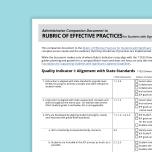
(bright music) - The vertical alignment not only helps me draft IEP goals for my students that are meaningful and help support their individual needs while aligning to the TEKS, but it also helps me plan instruction. I use the vertical alignment for doing IEP goal writing, but also for lesson planning. I take it with me to weekly meetings with the gen ed teachers. It helps me determine how students on my caseload will participate in classroom activities in their rooms for the rest of the week.
For instance, let's explore one of my student's profiles. I have a student named Isaac. He's in eighth grade. He's 14.
He has a diagnosis of intellectual disability. Some things you'll need to know about Isaac are that he can match images, objects, and words. He can attend to a task up to 15 minutes in length, and he works really well in partners and small groups. He does get overwhelmed during large group, campus, and community events.
He needs some sensory supports because he reacts to some noises and smells. Isaac also has some communication needs, which we will talk about more in the assistive technology and modes of communication sections in a moment. On his IEP, he is working on using similarities to classify objects, second grade sight words, and greater than, less than up to the number 20. He uses assistive technology.
He's got noise-reducing headphones that help him with some of his sensory issues. He uses a GoTalk 32 as his communication device, and he uses visual supports all day as response cards to tasks, an individual schedule that has photos of the activities he will be doing, and mini schedules for work tasks that have a lot of steps. His modes of communication are his GoTalk 32. He points to image cards to respond.
He does have some word approximations, he just doesn't have very good articulation, and his vocabulary for oral speech is very small. His reinforcers are trains, goldfish crackers, and he loves snap cubes. So knowing that about Isaac and that he's in the eighth grade and will be going to participate in his general education science class, we need to make a plan for how he will engage in the lesson. His peers will be working on 8.5
from the TEKS, matter is composed of atoms and has chemical and physical properties. That is pretty tough. I have printed out the vertical alignment so I can see which prerequisite skill might help Isaac get access to his grade-level TEKS. You'll notice on the vertical alignment how the material is arranged from the less complex pre-kindergarten skills to the more complex grade-level skills.
Here you'll see the activities a student needs to be able to do for 8.5 from the TEKS. His peers are going to be working on interpreting the arrangement of the periodic table, including the groups and periods, to explain how properties are used to classify elements. Well, what I know about Isaac from his profile sheet is that he is going to be able to do this with some added supports.
Using the vertical alignment, I'm gonna find a prerequisite skill as an access point to this grade level skill for Isaac. Looking at this first grade skill that is also connected to matter and energy, Isaac could classify objects by observable properties such as larger and smaller, heavier and lighter, shape, color, and texture. This connects to one of his IEP goals from his profile sheet where he is using similarities to classify objects. Another one of his IEP goals from his profile sheet was greater than, less than up to 20, and you'll see that connected in our lesson plan as well.
I met with the general education science team to discuss the activities they're gonna be using with the class to teach about atoms and the periodic table. The class is going to be exploring the periodic table during a large group discussion. During this activity, Isaac will be matching the first 20 elements to their places on the periodic table. Using this large-scale periodic table and these image cards, Isaac will match each card onto the table.
In small groups, the class is going to be talking about how the elements on the periodic table are arranged by atomic number, their number of protons. Since Isaac is working on the relationship of the numbers 1 through 20, during the group activity, he's going to be comparing the atomic number and some of the elements using additional supports. He will choose two of the first 20 element cards and compare the atomic number using the appropriate symbol card. He can share the information with his peers using these response cards, or he can make comments using his communication system to indicate which one has more or less protons.
Lastly, while the class is working on an independent activity, classifying elements into groups, Isaac will be sorting his response cards into groups using their color codes. This connects to his IEP goal of using similarities to classify objects. You can see how knowing my students and using the vertical alignment helps me plan their participation in grade-level lessons in ways that are meaningful and appropriate for their unique skill levels.