Accommodation Companion Guides
Inclusion, Assistive Technology, ARD/IEP Supports, Instruction
Our companion guides bridge existing student accommodations to assistive technology (AT) options that enable access to greater student progress within the High Quality Instructional Materials (HQIM)
Accommodation Companion Guides
Purpose and Functionality
These quick reference documents can be used by both general and special educators to identify support options that meet individual student support needs.
Removing Barriers for Students
Accommodations are changes to materials or procedures that enable students with disabilities or English learners to participate meaningfully in learning and testing. Student support committees consider whether changes in presentation, response, setting, timing or scheduling are required for students to access the general curriculum. Support committees consider data on the impact of a student’s disability or language acquisition, their strengths, and their needs. While each need is different, some accommodations can be leveraged more frequently and in more ways than others. The accommodations included in the companion guides are not meant to be an exhaustive list. The examples listed are intended to highlight high-leverage tools that align with supports frequently found in existing student plans.
Bridging Supports
The accommodation companion guides are intended to be a bridge between existing student support plans and the support features available within the High-Quality Instructional Materials (HQIM). The column on the left of each document lists frequently used accommodation terminology. The column on the right identifies the platform tool that can be used to provide the accommodation. The middle column serves as a broad description linking general accommodation terms to the specific content platform functions. This allows educators to quickly and easily align platform functions to previously identified student needs. The chart layout also allows educators to identify a content platform function that allows for greater access and/or progress for an individual student. The chart can also be read from right-to-left to identify terminology that is understandable in a support document to individuals not utilizing the Texas Education Agency HQIM.
Drive to Discover
The accommodation companion guides are quick reference documents that can be used by both general and special educators to identify some of the support options within each content platform. While a few of the more utilized supports are outlined, they are not representative of all supports that are available.
An additional intended impact these documents have is to drive educators and students to the various locations that supports can be accessed, implemented, or personalized depending on the specific content platform. This will allow for improved student access and for learning experiences to be as unique as the student.
English Guides
Inclusion, Assistive Technology, ARD/IEP Supports, Instruction
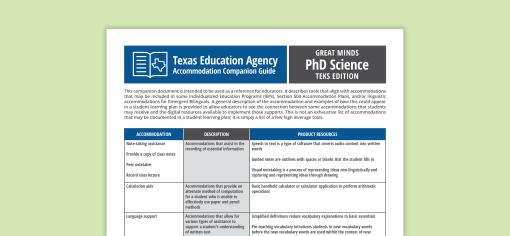
PhD Science Accommodation Companion Guide
Inclusion, Assistive Technology, ARD/IEP Supports, Instruction
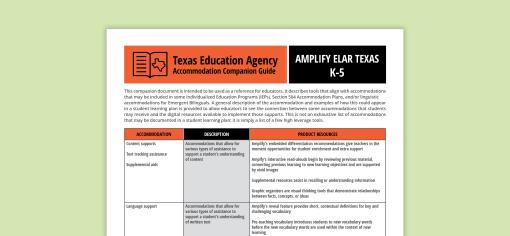
Amplify K-5 Accommodation Companion Guide
Inclusion, Assistive Technology, ARD/IEP Supports, Instruction
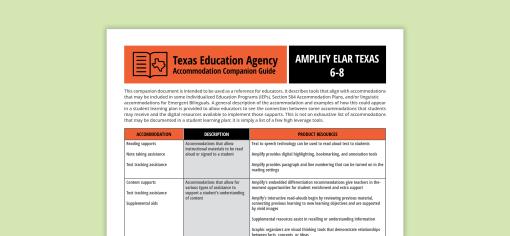
Amplify 6-8 Accommodation Companion Guide
Inclusion, Assistive Technology, ARD/IEP Supports, Instruction
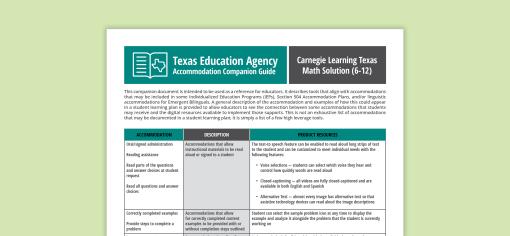
Carnegie Accommodation Companion Guide
Inclusion, Assistive Technology, ARD/IEP Supports, Instruction
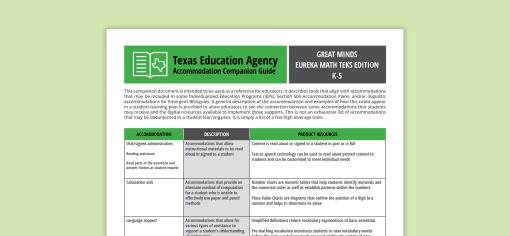
Eureka Math TEKS Edition K-5 Accommodation Companion Guide

Inclusion, Assistive Technology, ARD/IEP Supports, Instruction
ODELL Accommodation Companion Guide
Spanish Guides
Inclusion, Assistive Technology, ARD/IEP Supports, Instruction
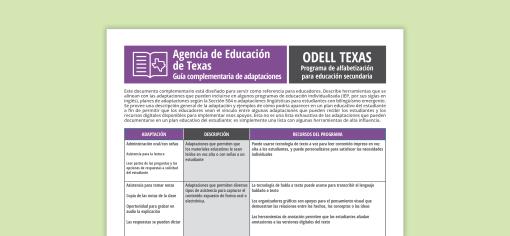
ODELL Guía Complementaria de Adaptaciones
Inclusion, Assistive Technology, ARD/IEP Supports, Instruction
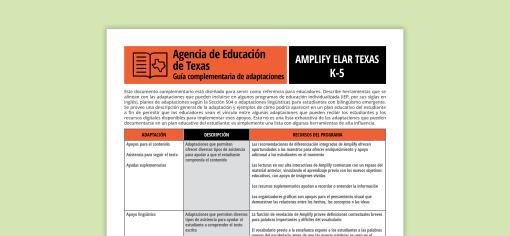
Amplify K-5 Guía Complementaria de Adaptaciones
Inclusion, Assistive Technology, ARD/IEP Supports, Instruction
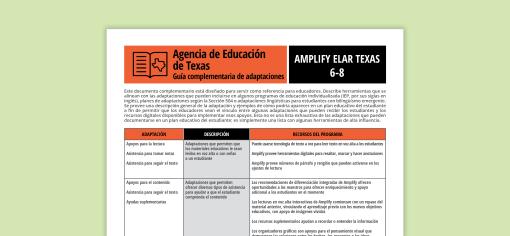
Amplify 6-8 Guía Complementaria de Adaptaciones
Inclusion, Assistive Technology, ARD/IEP Supports, Instruction
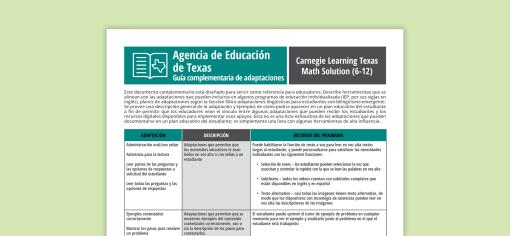
Carnegie Guía Complementaria de Adaptaciones
Inclusion, Assistive Technology, ARD/IEP Supports, Instruction
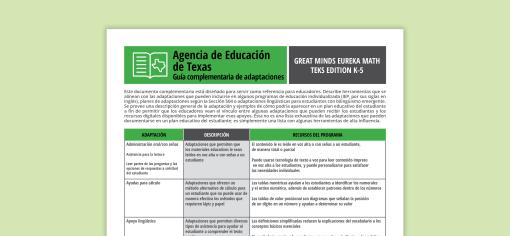
Eureka Math TEKS Edition K-5 Guía Complementaria de Adaptaciones
Inclusion, Assistive Technology, ARD/IEP Supports, Instruction
